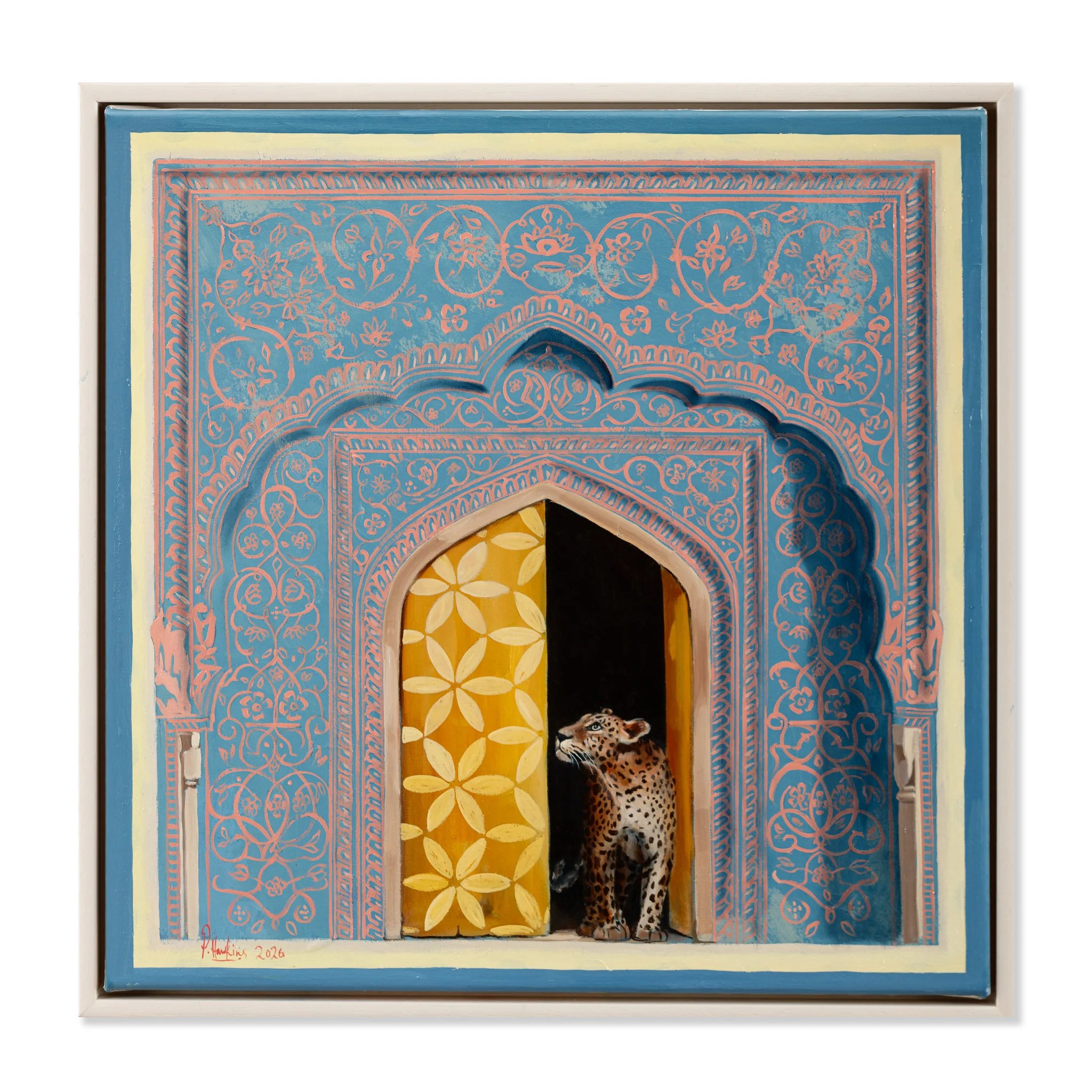
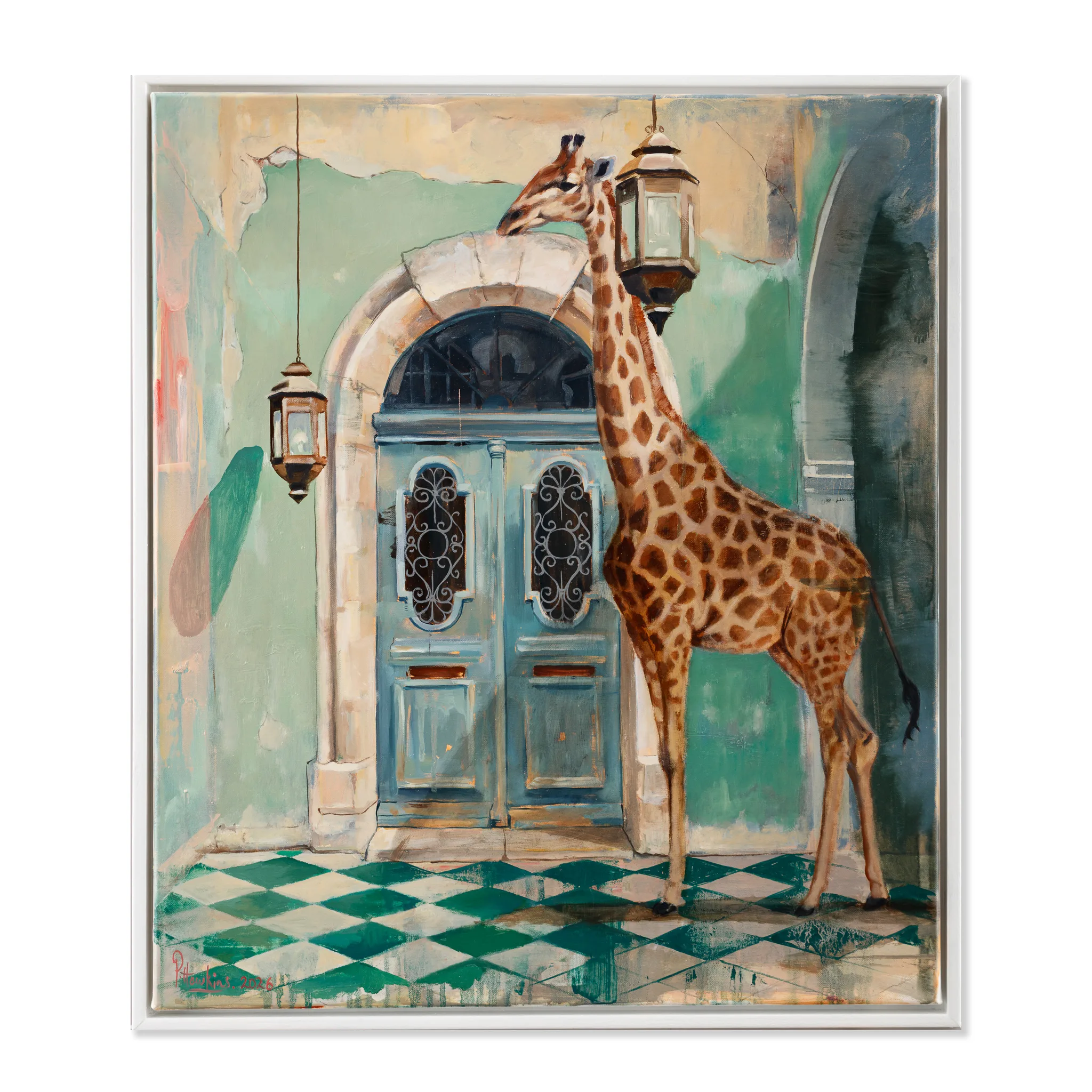
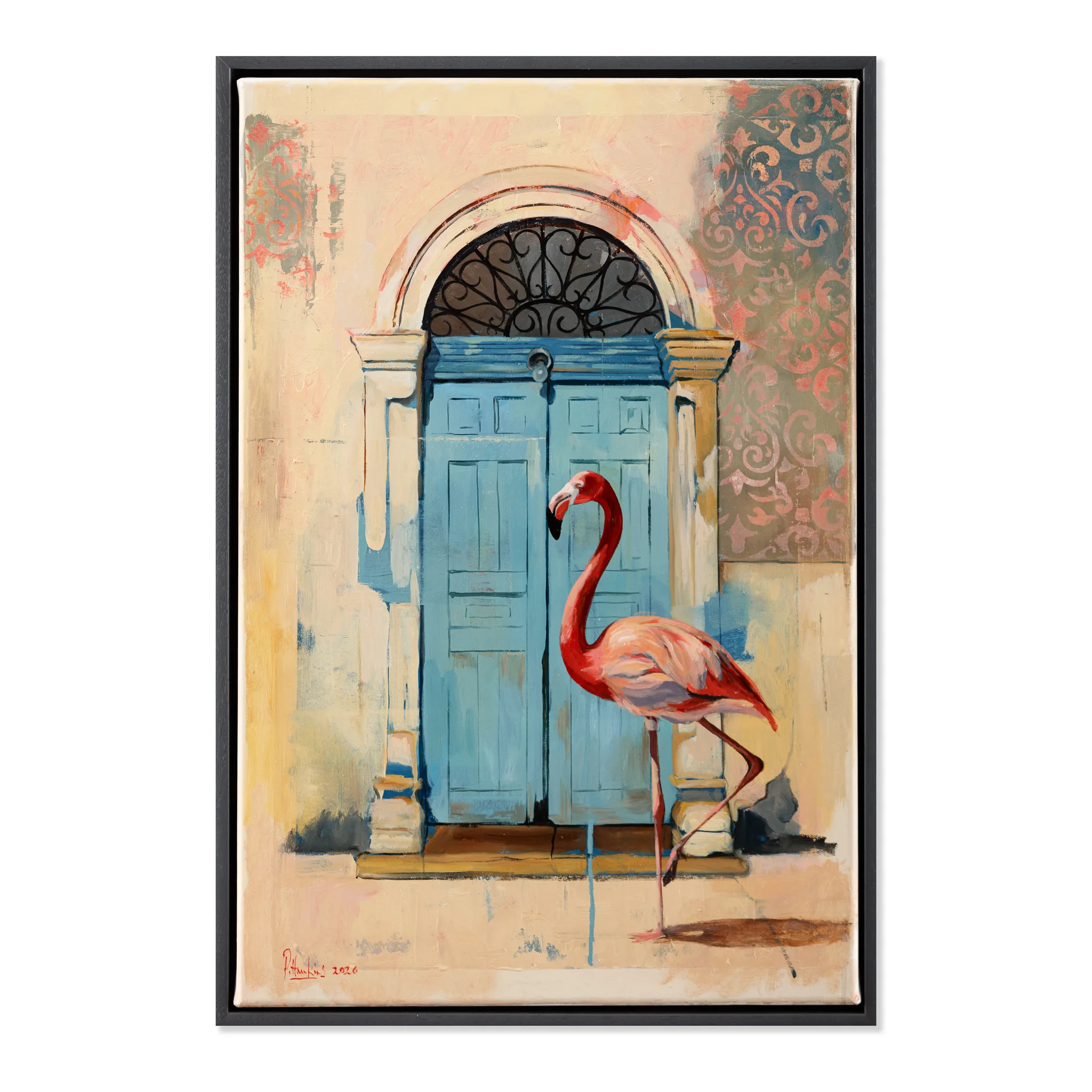
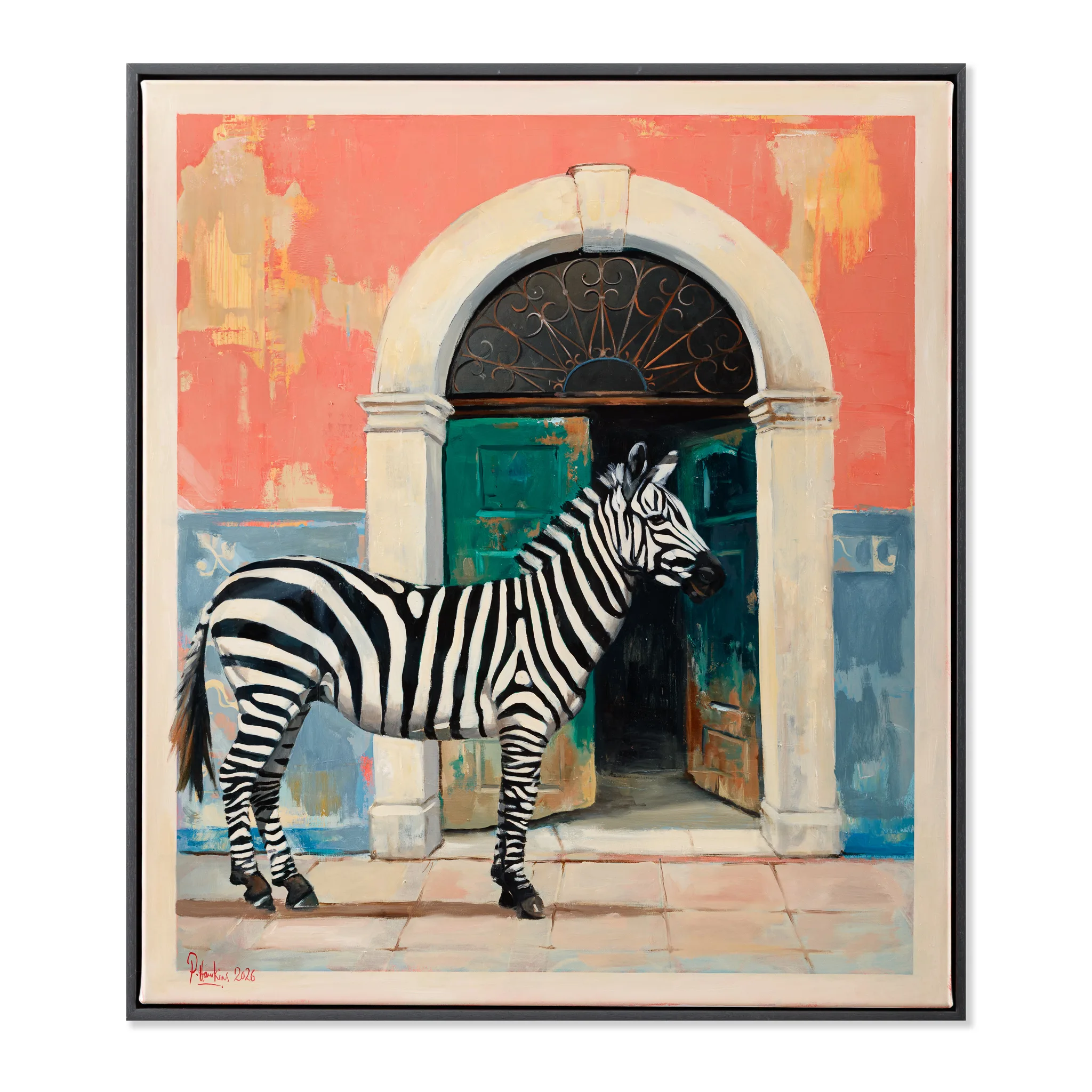
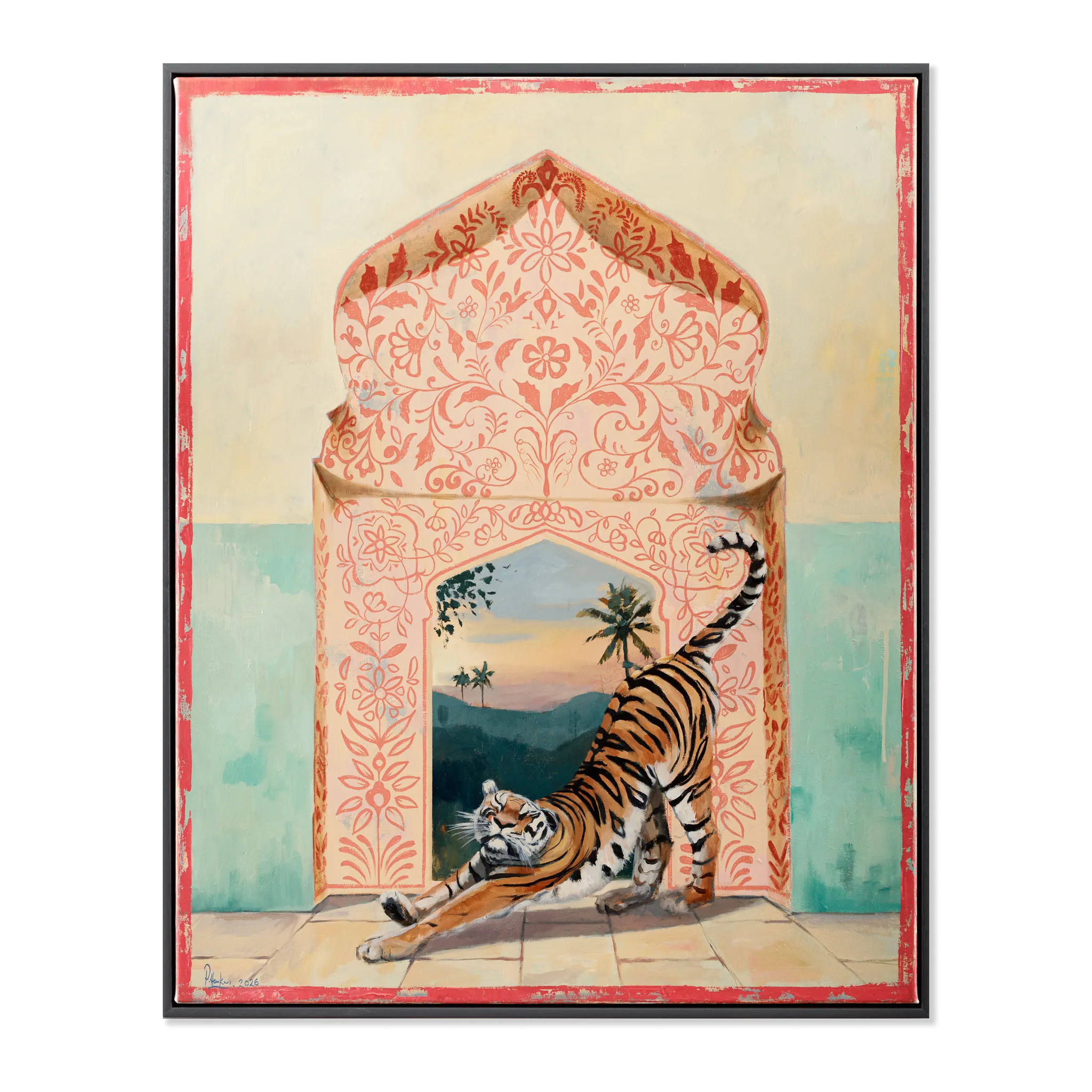
Pete Hawkins and I have worked together a fair few times now. He is a contemporary figurative artist based in Suffolk whose paintings have a very distinctive identity, and every time he needs new photographs of his work, he comes to the studio at Bentwaters. The latest session involved seven pieces, and I have included them all in this post.
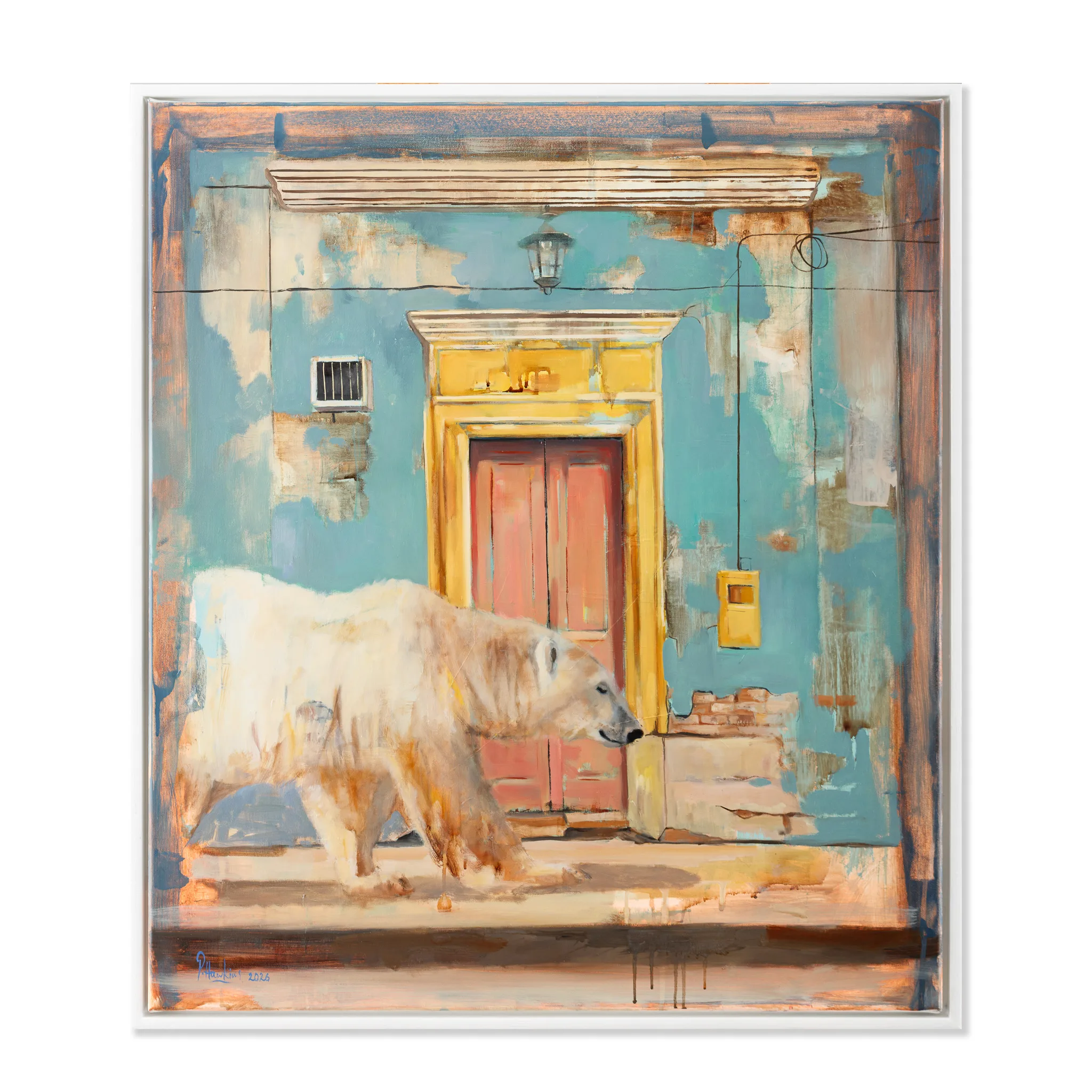
If you are familiar with Pete’s work, you will know what to expect: exotic animals placed within richly detailed architectural settings drawn from across the world. Mughal arches. Moroccan doorways. Weathered Mediterranean facades. A leopard, a giraffe, a flamingo, a zebra, a tiger, a polar bear. Each one inhabits its setting with a presence that feels entirely natural, which is no small thing to pull off. His work has a very clear visual language, and it is always recognisably his.
Getting photographs that do that work justice requires a particular approach. Here is how I go about it.
Why Pete Needs Professional Photographs of His Paintings
Pete uses these photographs in two distinct ways.
The first is for his website and promotional materials. He needs images that represent his paintings accurately online, with colours and tones that genuinely reflect the originals.
The second is more technical. Pete produces limited edition print runs from his paintings, and for that the files need to carry enough information to hold up at print. The image needs to contain the full colour range, tonal depth, and fine detail of the original canvas. A photograph taken on a phone, or even with a general purpose camera setup, will not deliver that reliably. What you tend to get is a reproduction that has drifted from the original in ways that may be subtle but are clearly there when you look at the two side by side.
This is why artwork photography, done properly, is a specialist task.
Setting Up the Studio for Artwork Photography
When artists bring work to the studio, the setup is built around the specific demands of the job.
Lighting a painting is nothing like lighting a person. There is no expression to draw out, no mood to create, no movement to work with. What matters is that the light across the entire surface of the canvas is completely even, flat and consistent from edge to edge. On a larger canvas this becomes critical, because any variation in the light, however slight, will produce inconsistency in tone or exposure across the image. That inconsistency does not belong to the painting. It belongs to the photography, and it needs to be eliminated.
I use software during the shoot to verify the colour accuracy of what the camera is capturing. Rather than relying on the monitor to tell me what I am looking at, the software measures the colour, saturation, and tonal values and confirms that they match the original. By the time we have finished, the colour in the photograph is the colour of the painting. Not my best approximation of it, not a close match, but the actual colour.
It means I do not have to adjust anything after the fact. The image is accurate from the point of capture.
A Note on Monitor Calibration
I mention this to most artists who are new to working with me, and it is worth putting in writing.
When you receive your files and view them on your screen, what you see is affected by how that monitor is set up. If the brightness is too high, or if the colour profile has drifted, you will see tones and colours that do not accurately reflect what is in the file. It is a common and understandable source of confusion, and it can lead to the incorrect conclusion that the photography is wrong, when in fact the photography is correct and the screen is the variable.
Because I shoot with calibration software, the colour and tone are established at the point of capture. I do not need to change them in post-processing, because there is no ambiguity. If an image looks slightly different on a particular screen, the answer is to look at the screen, not at the file.
File Formats and Long-Term Archiving
Most artists receive their files as high resolution JPEGs, which are well suited to web use and most promotional applications.
Pete also receives TIFFs. Because he is going to print, the TIFF format gives him more to work with. It carries more image information than a JPEG and handles the demands of commercial printing at scale more reliably.
Over the years we have been working together, we have set up a shared Google Drive. Pete has a running archive of all the high resolution TIFFs from every session, which he can access at any point. For an artist who regularly produces print editions, having that archive in one accessible place is genuinely practical. It removes the risk of losing files between sessions and means he can go back to earlier work at any time without having to come back to the studio.
What to Expect If You Are an Artist Looking to Have Your Work Photographed
I offer a straightforward rate for artwork photography and prefer to keep things clear, with no ambiguity about what you are getting.
One thing I always flag with new clients, and it is worth mentioning here: if you are bringing drawings or other work on textured or tinted paper, the paper will appear in the final image. I am reproducing what is there. If your work is on ivory paper, the background of the photograph will be ivory. If the paper has a texture, that texture will be visible. I am not able to strip that out, and it would not be right to do so, because the paper is part of the piece.
What good artwork photography does give you is resolution. I use a high resolution camera, which means the files can be enlarged significantly without any loss of quality. You end up with a flexible, durable asset that you can use across different contexts and different sizes, now or further down the line.
Pete’s Work
Pete has a pop-up show coming up at New Street Market in Woodbridge on 25th June 2026. If you are in the area and have any interest in contemporary figurative painting, it is worth going. His work has a boldness and a consistency that is difficult to summarise in words but immediately clear when you see it in person.
You can see his paintings and prints at www.pete-hawkins.co.uk and follow his work on Instagram at @phawkart.
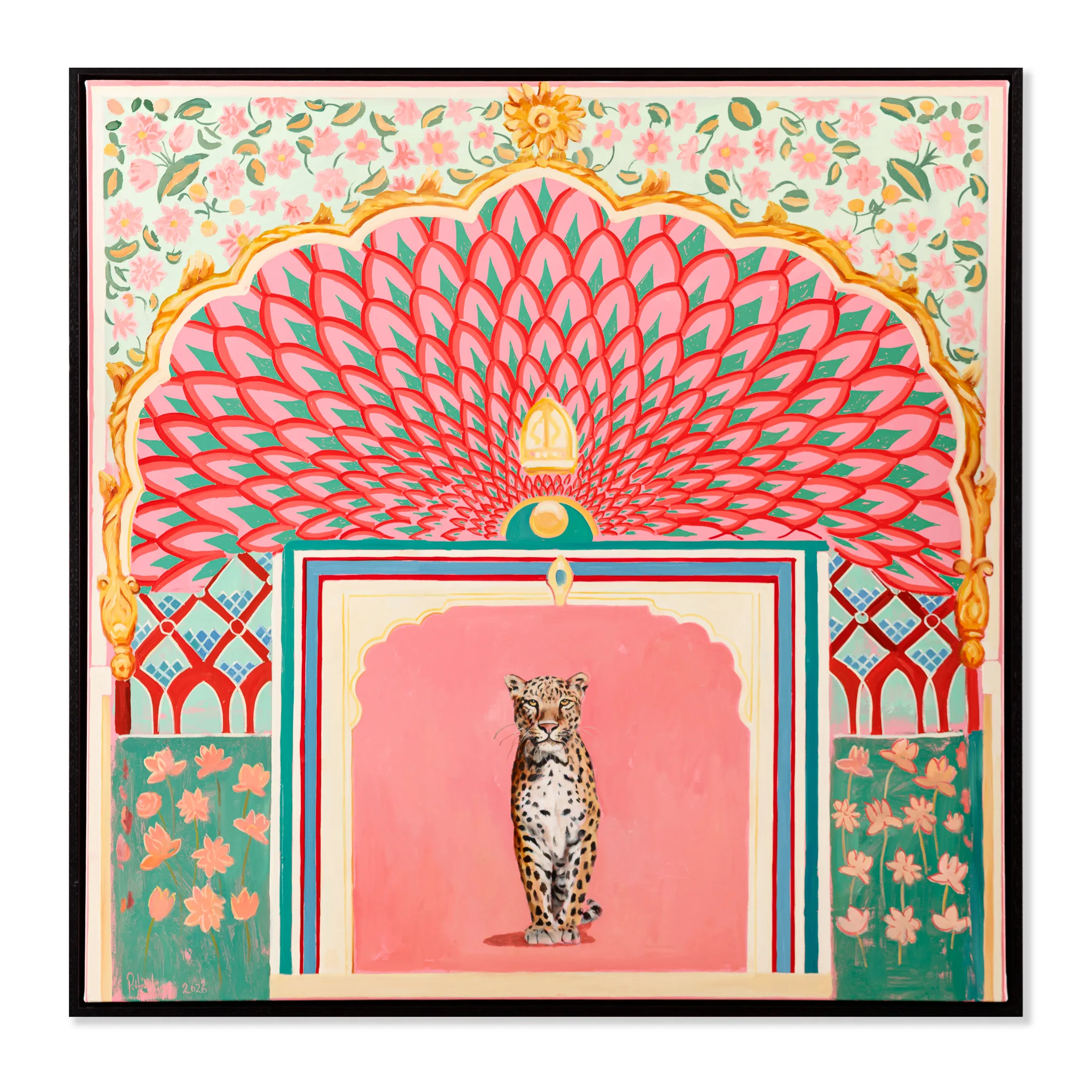
Artwork Photography at Foyers Photography, Bentwaters
The studio is at Base Business Park, Rendlesham, on the former RAF Bentwaters site just outside Woodbridge in Suffolk. If you are an artist in Suffolk, Ipswich, or the wider East Anglia area and you need professional photographs of your paintings for your website, for print editions, or for exhibition documentation, feel free to get in touch and tell me what you have.
Commercial photography
Need photography for your business?
Photography for businesses across Suffolk, planned around how you will use it: premises, teams, products, events and PR. See what is involved and get a quote.