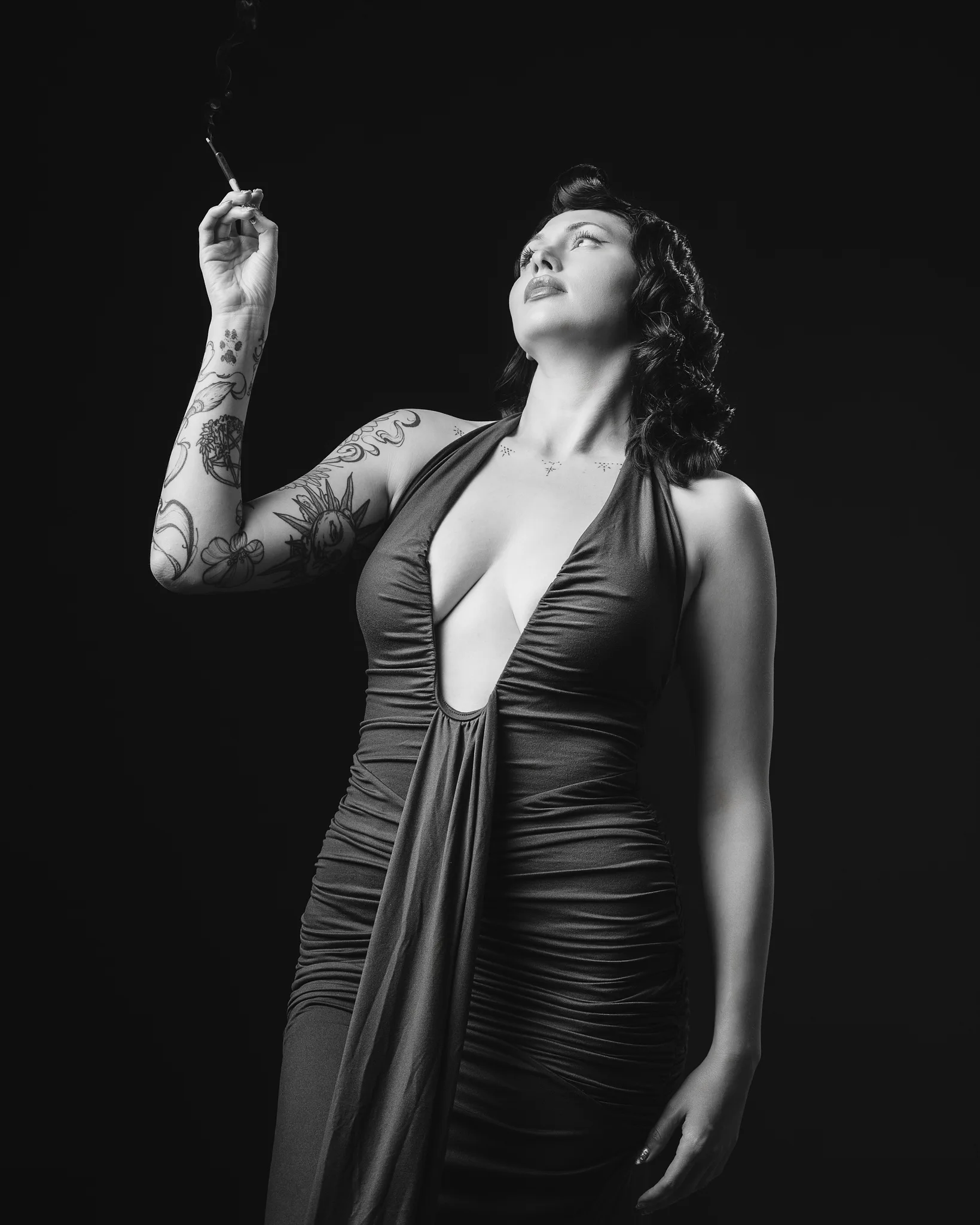
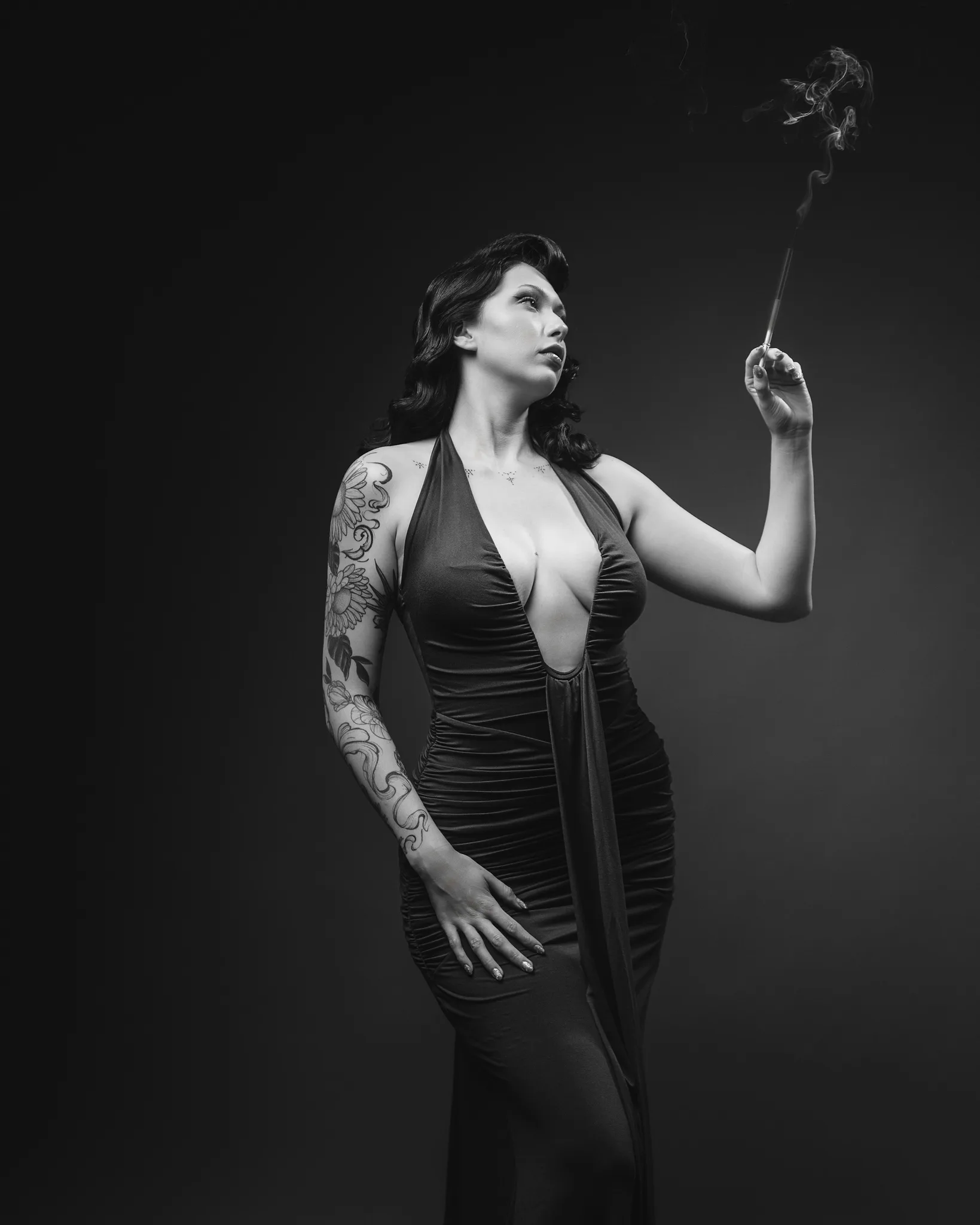
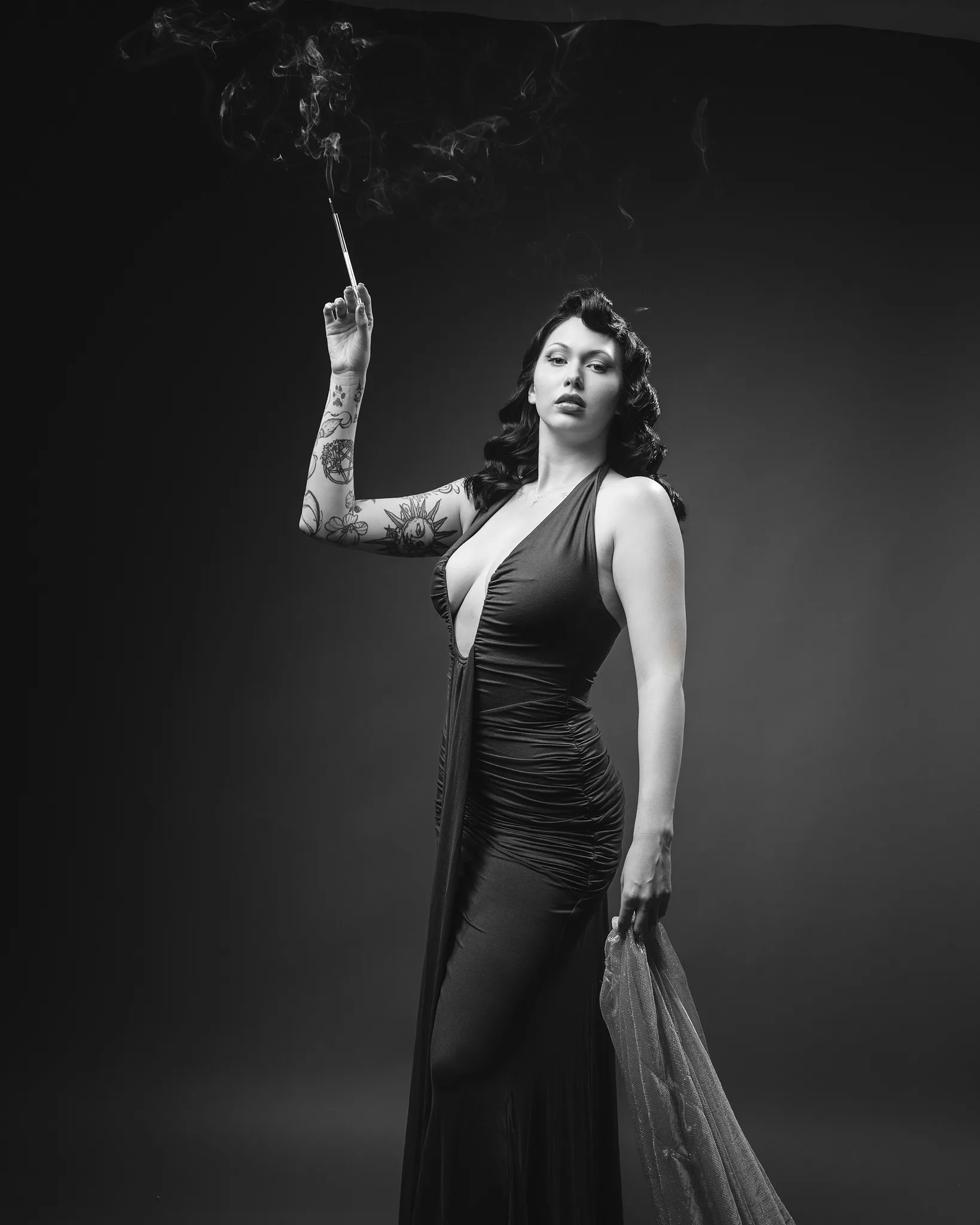
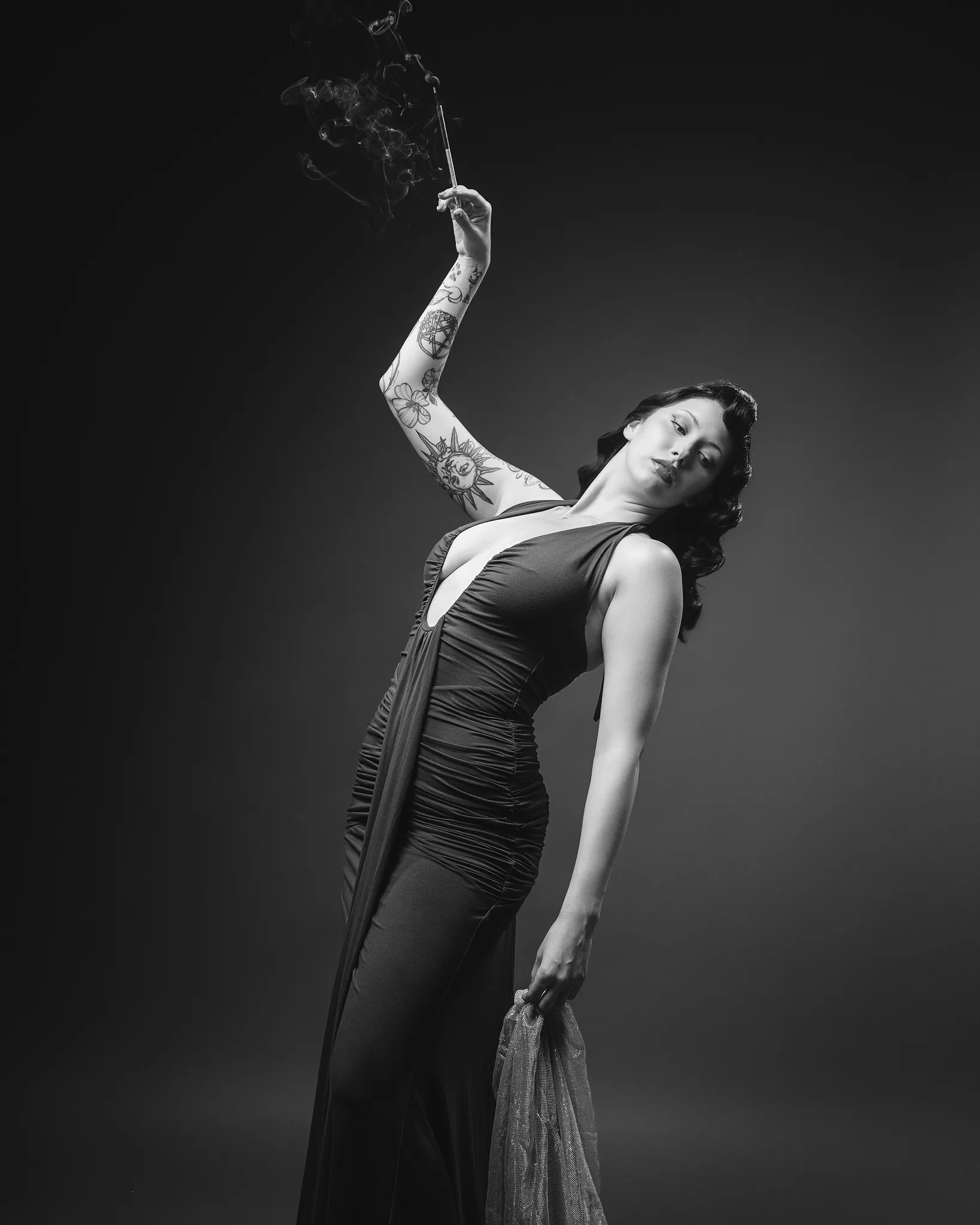
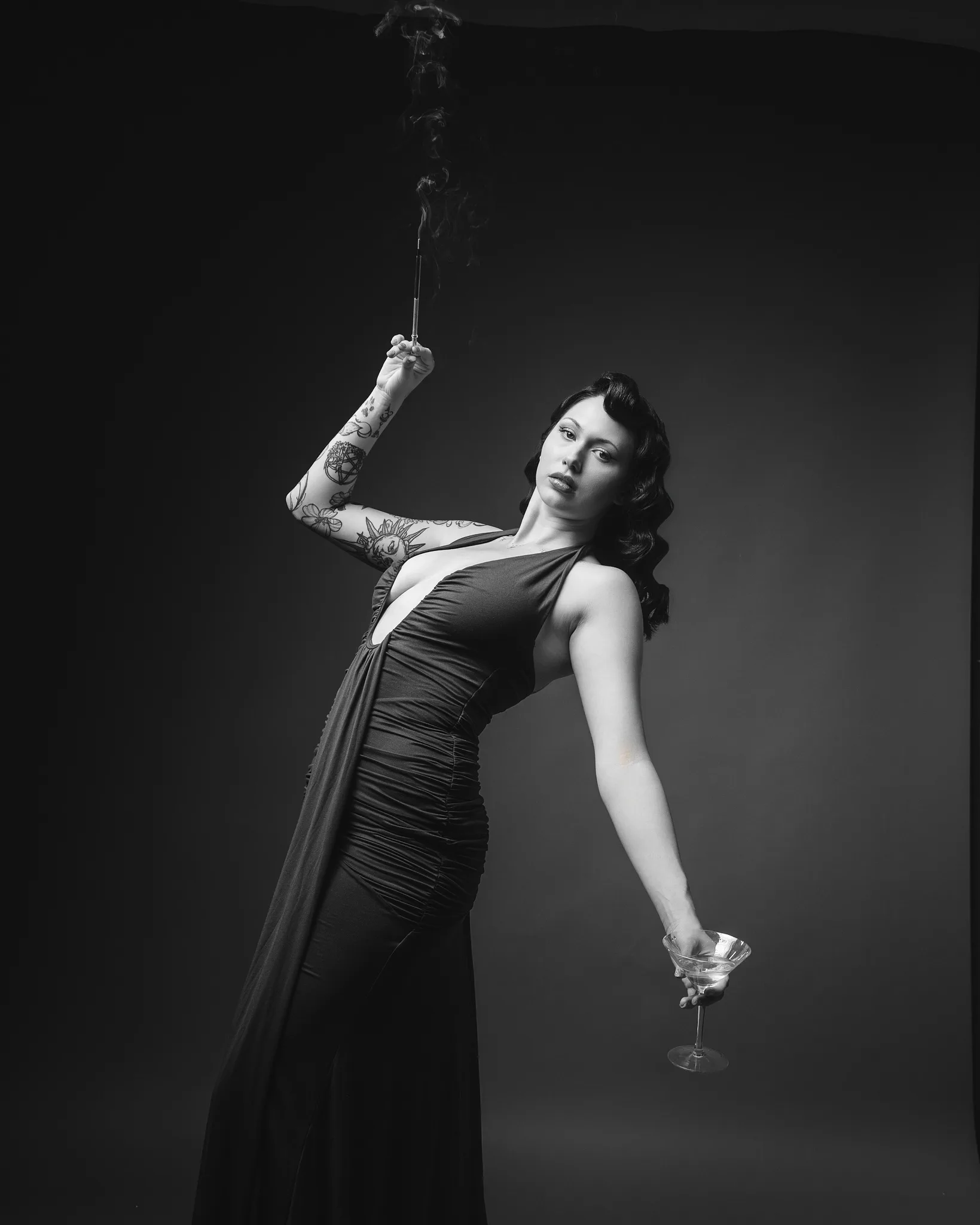
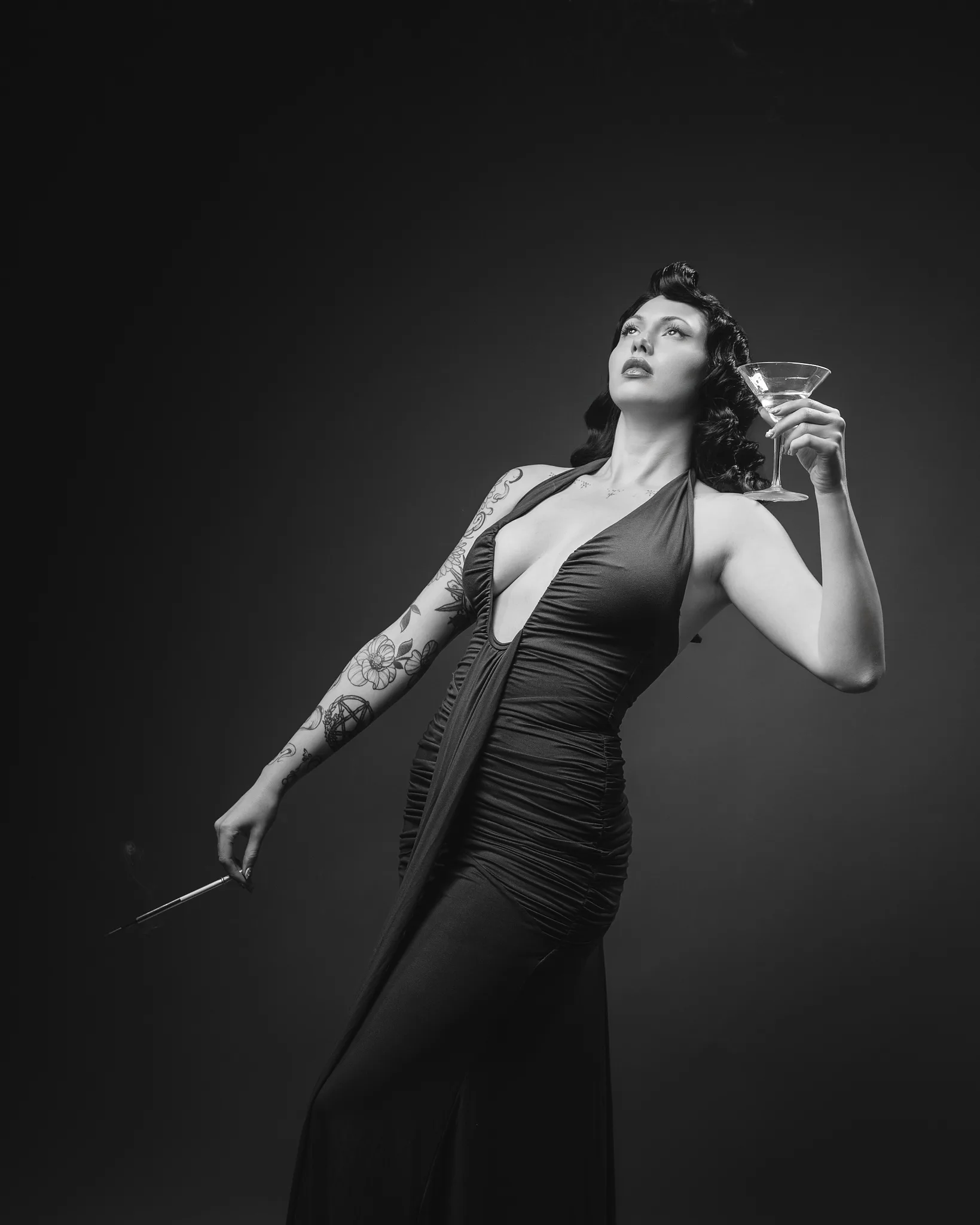
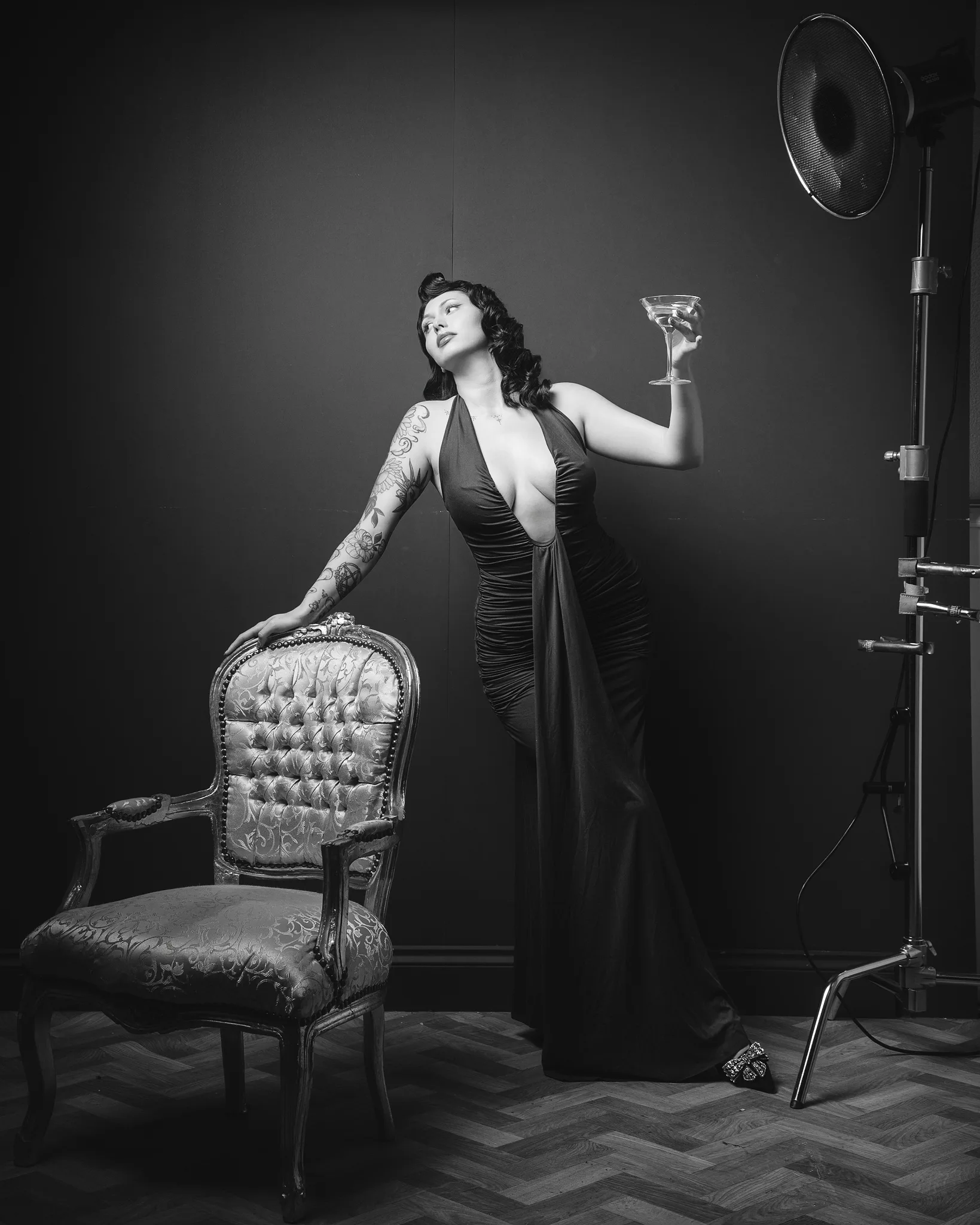
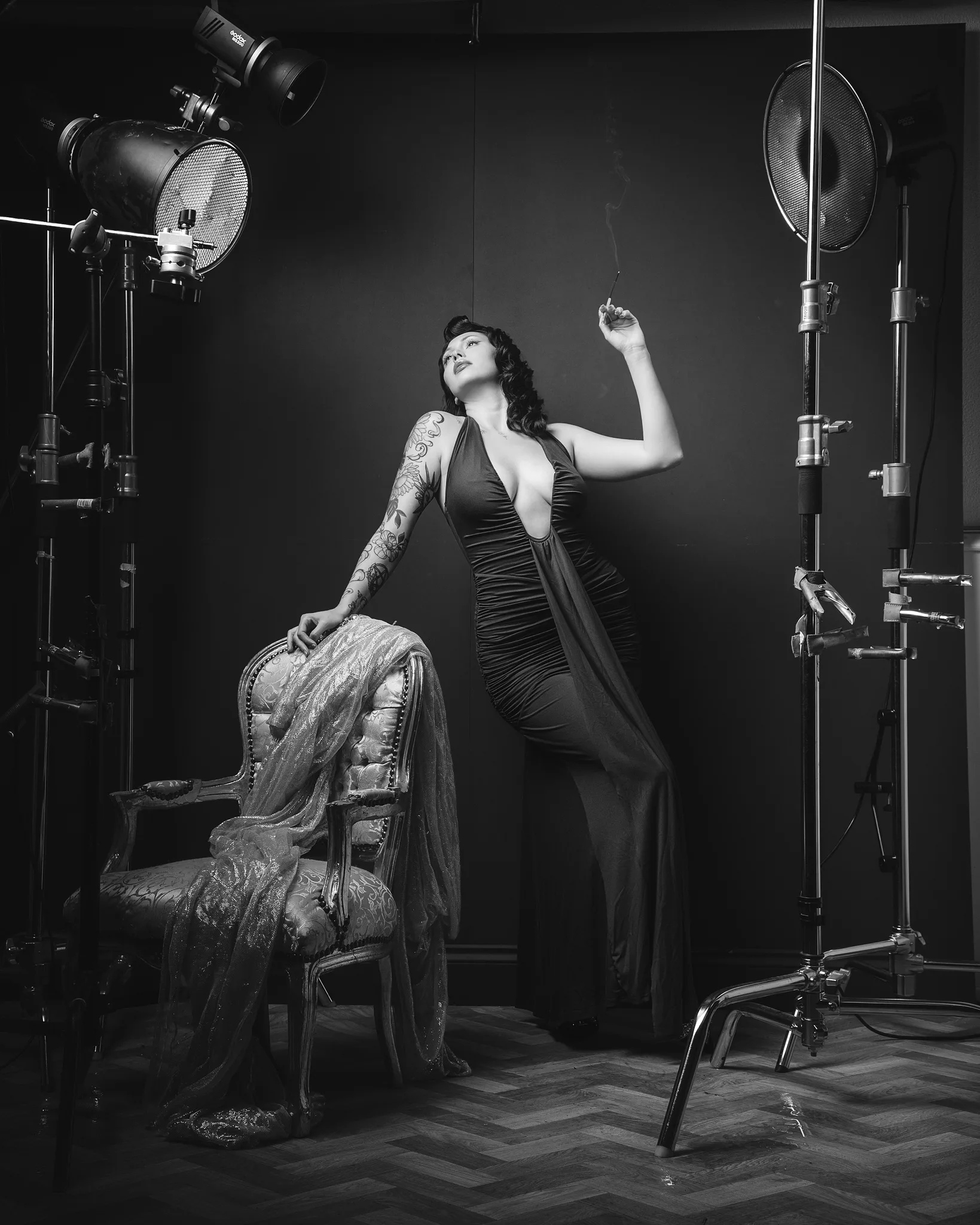
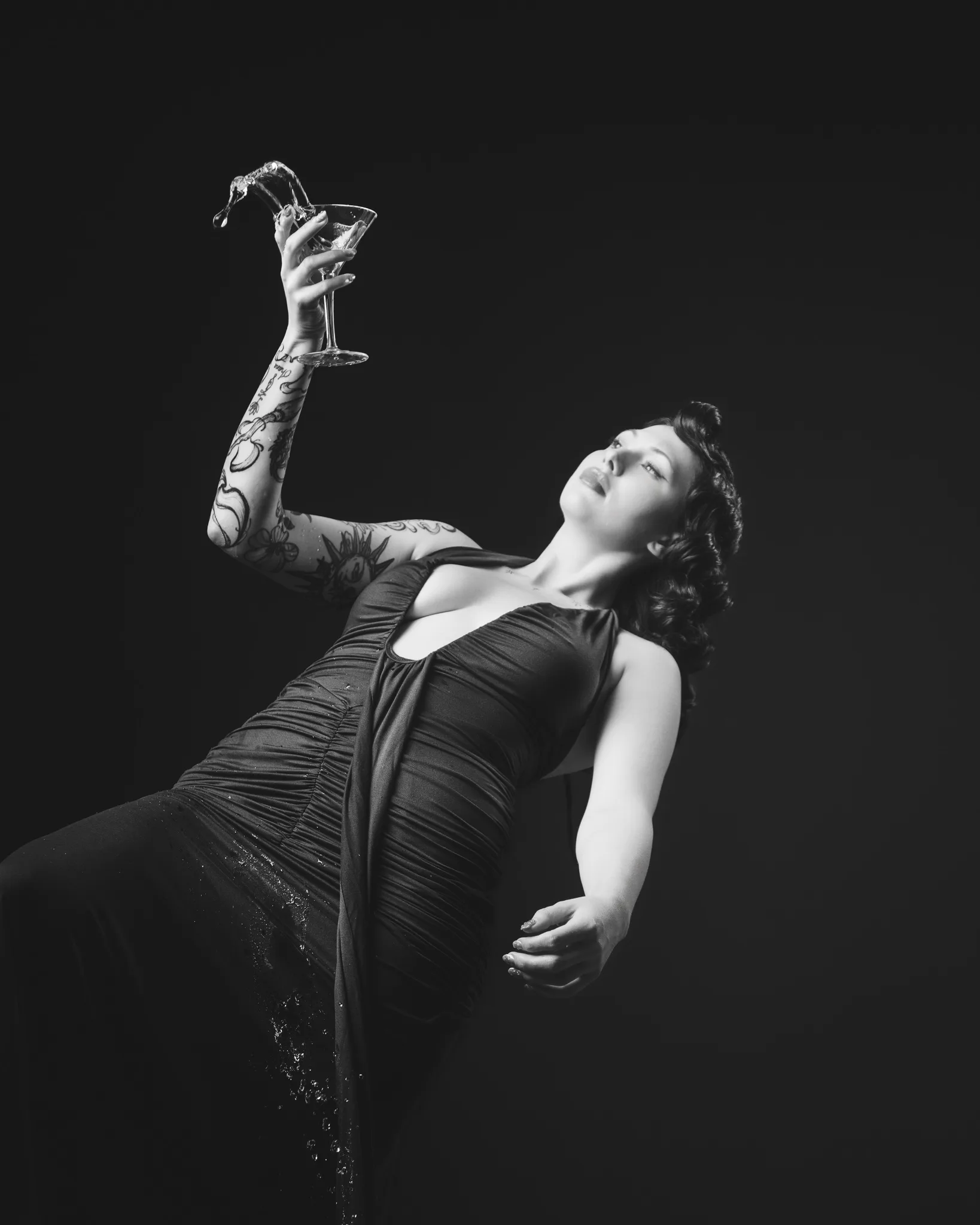
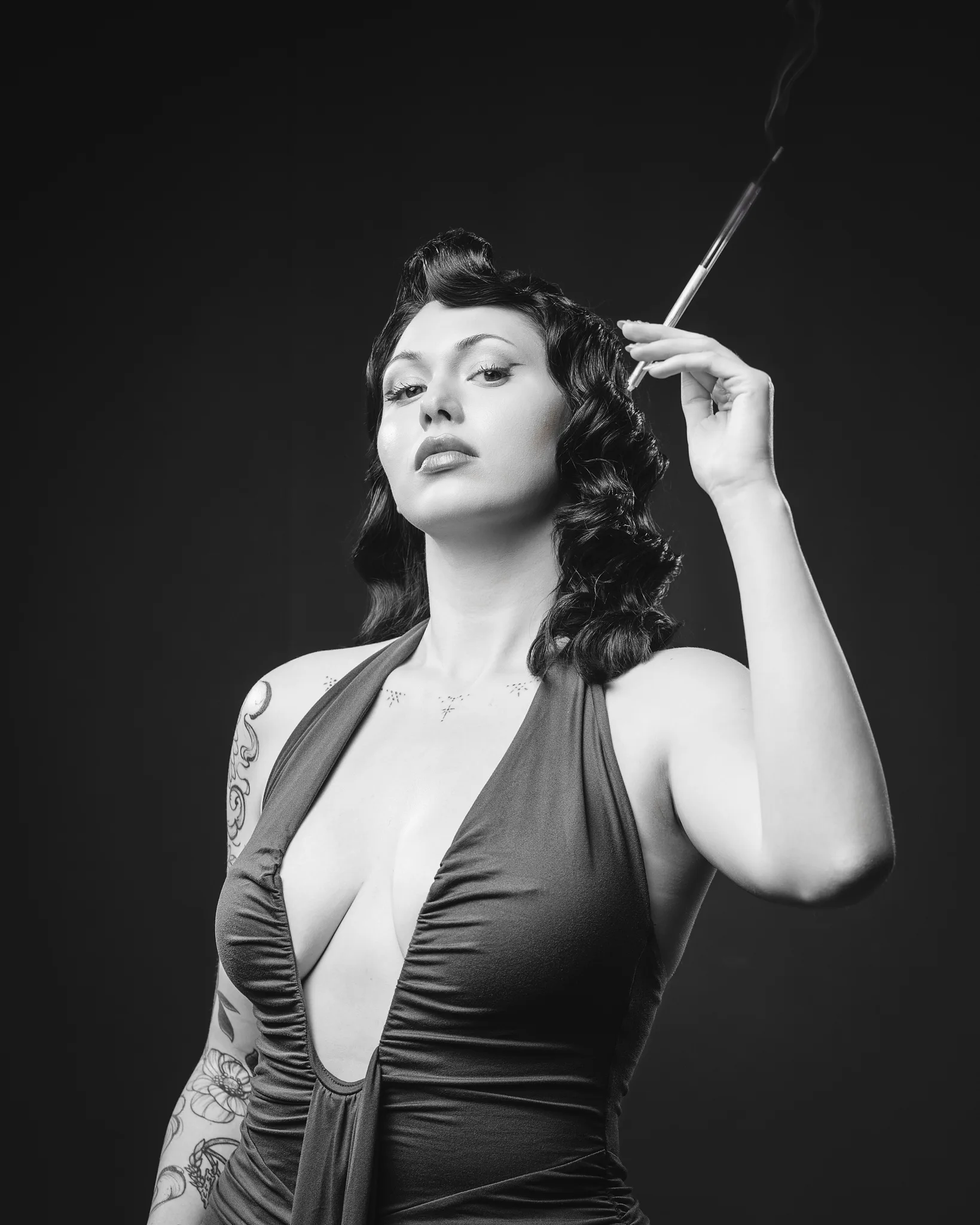
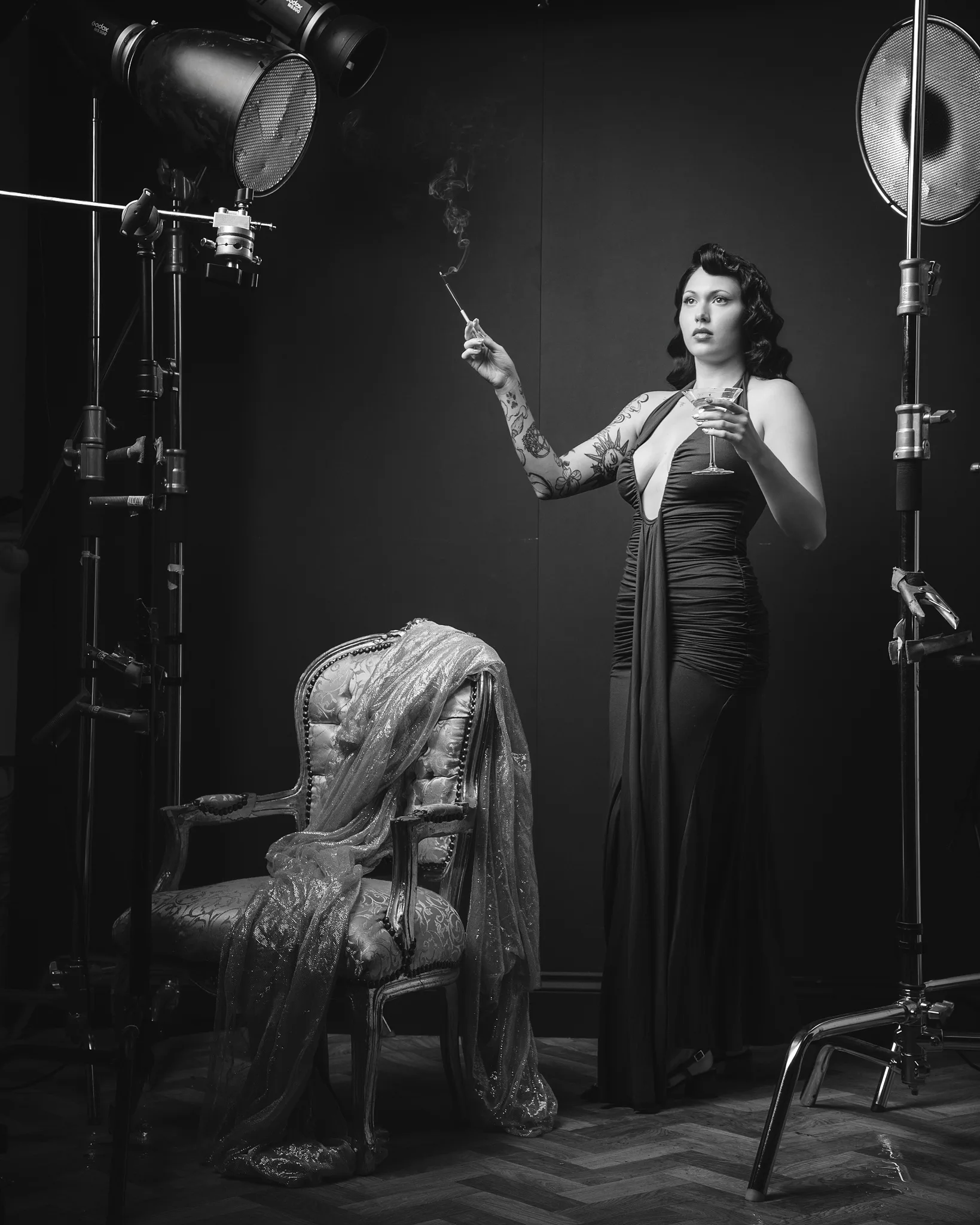
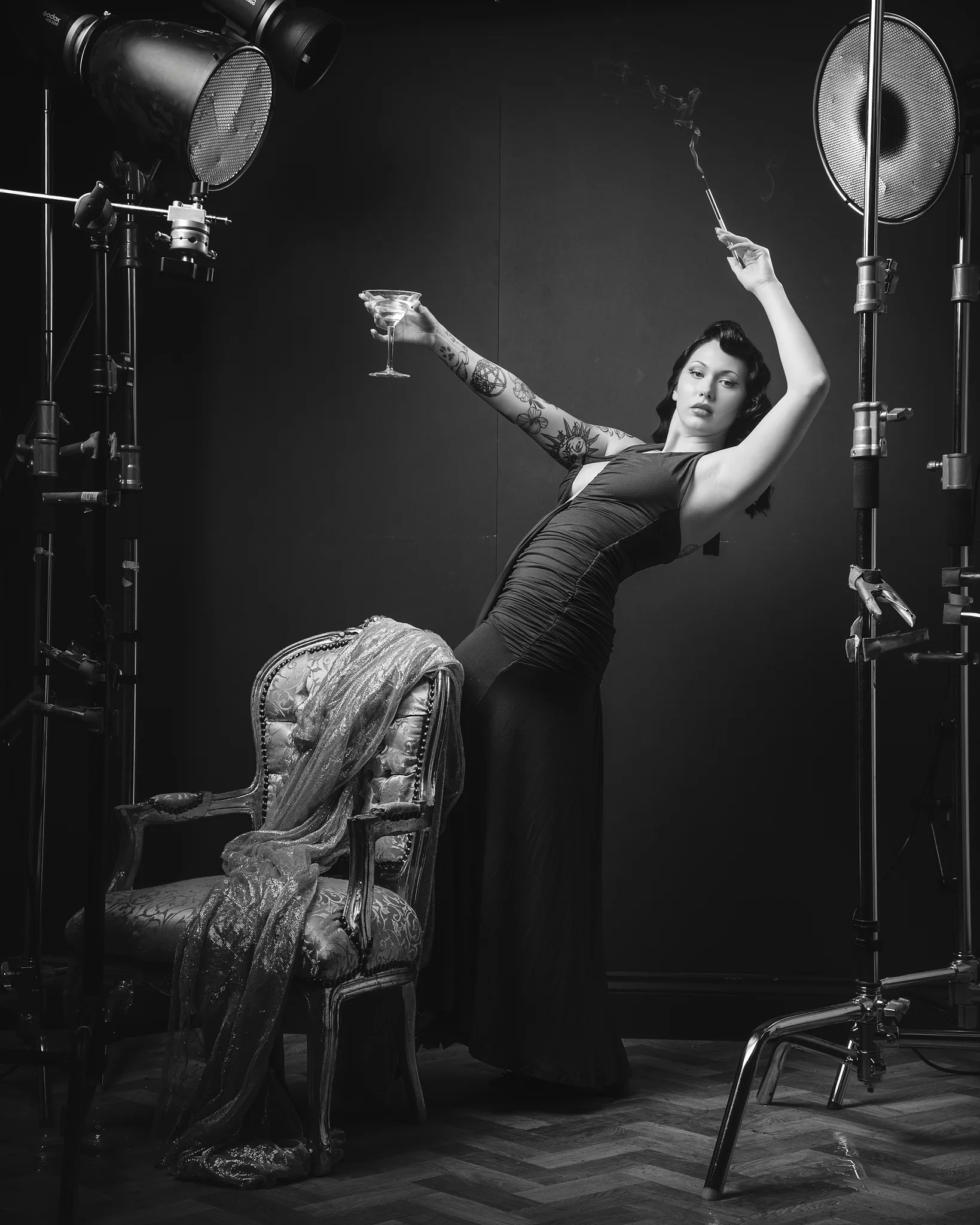
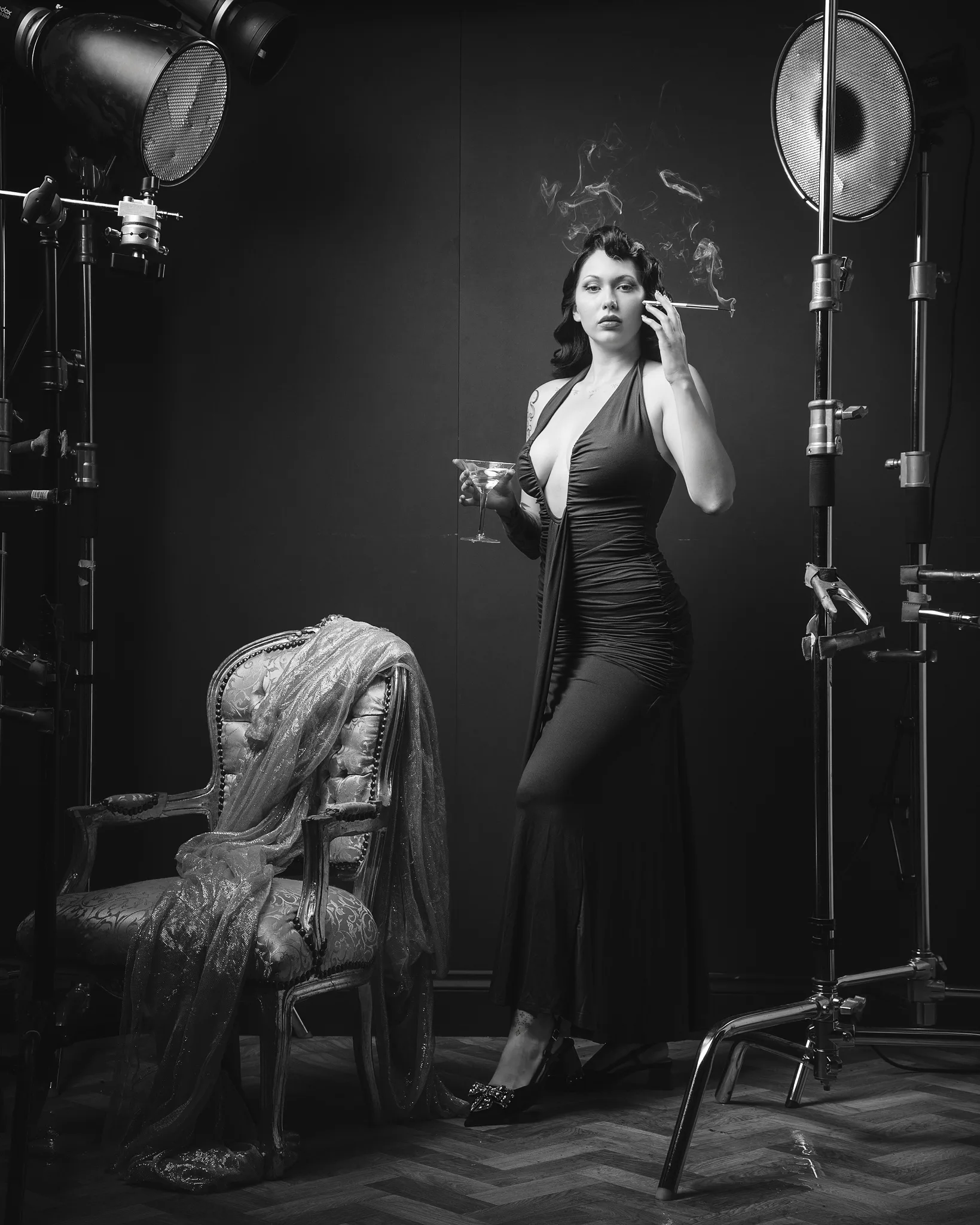
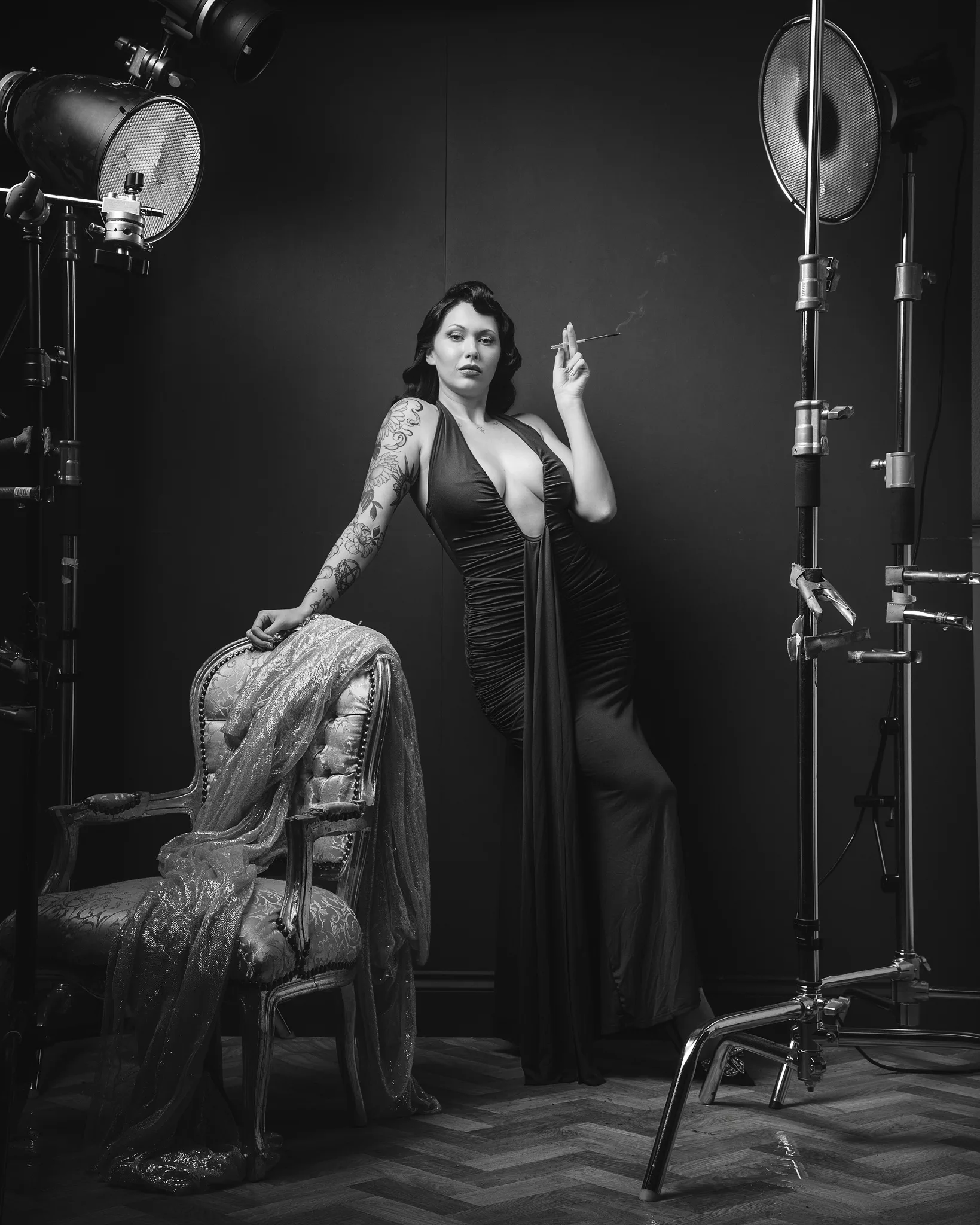
One hard light, a black backdrop, and a thin line of smoke lifting off a cigarette holder. A coupe glass catching the only bright edge in the frame. The idea behind this shoot was simple enough to say and hard to get right: take classic Hollywood glamour and rework it with a modern edge. Courtney sat at the centre of it, and everything else was built around holding that single mood in the room.
Where the look came from
The spine of this is George Hurrell. He was the photographer who shaped the Hollywood glamour portrait through the 1930s at MGM, working with the big names of the day. His pictures were built on hard light, deep blacks, and skin that looked sculpted rather than snapped. Nothing soft, nothing accidental. You looked at a Hurrell portrait and the person seemed lit from inside a shadow.
On top of that sits film noir. That came a little later, through the 1940s, and it is where the low key look really takes hold. One dominant light source, everything else falling away into black, high contrast doing the storytelling. It is the language of the femme fatale, the look you know from Rita Hayworth in Gilda or Lauren Bacall holding a room with a glance. I was not trying to copy any of those films frame for frame. I wanted the attitude of them, the sense that something is happening just out of shot.
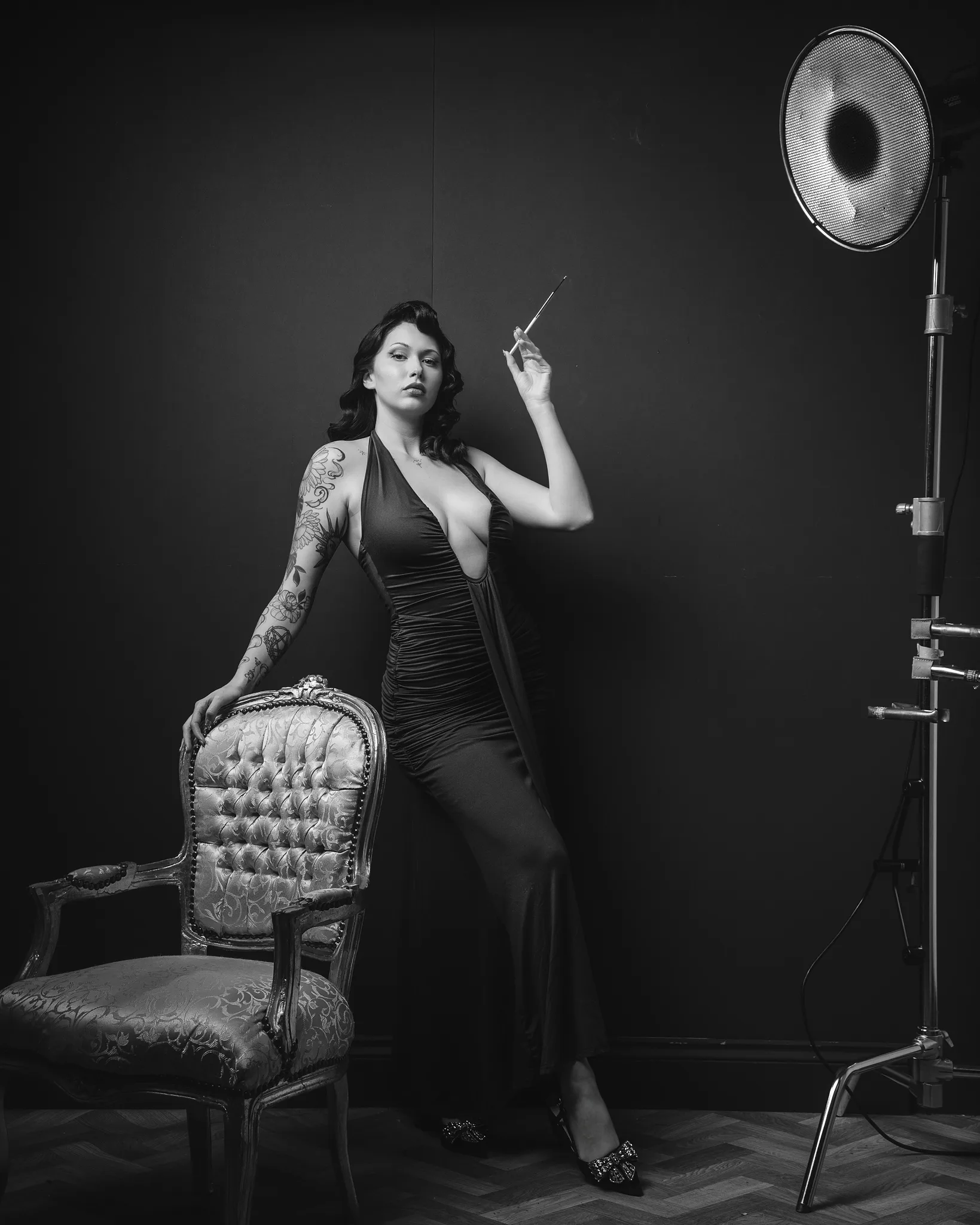
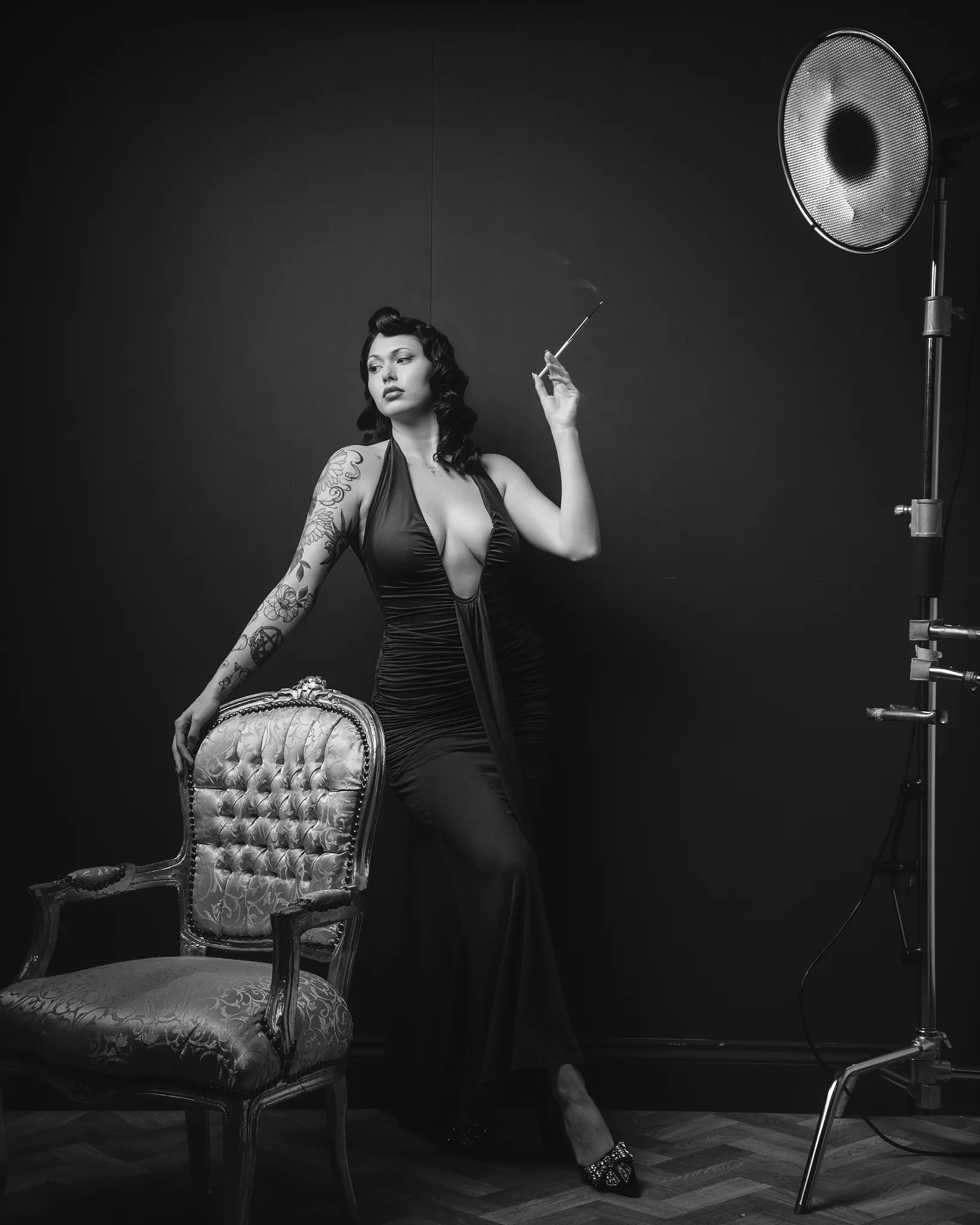
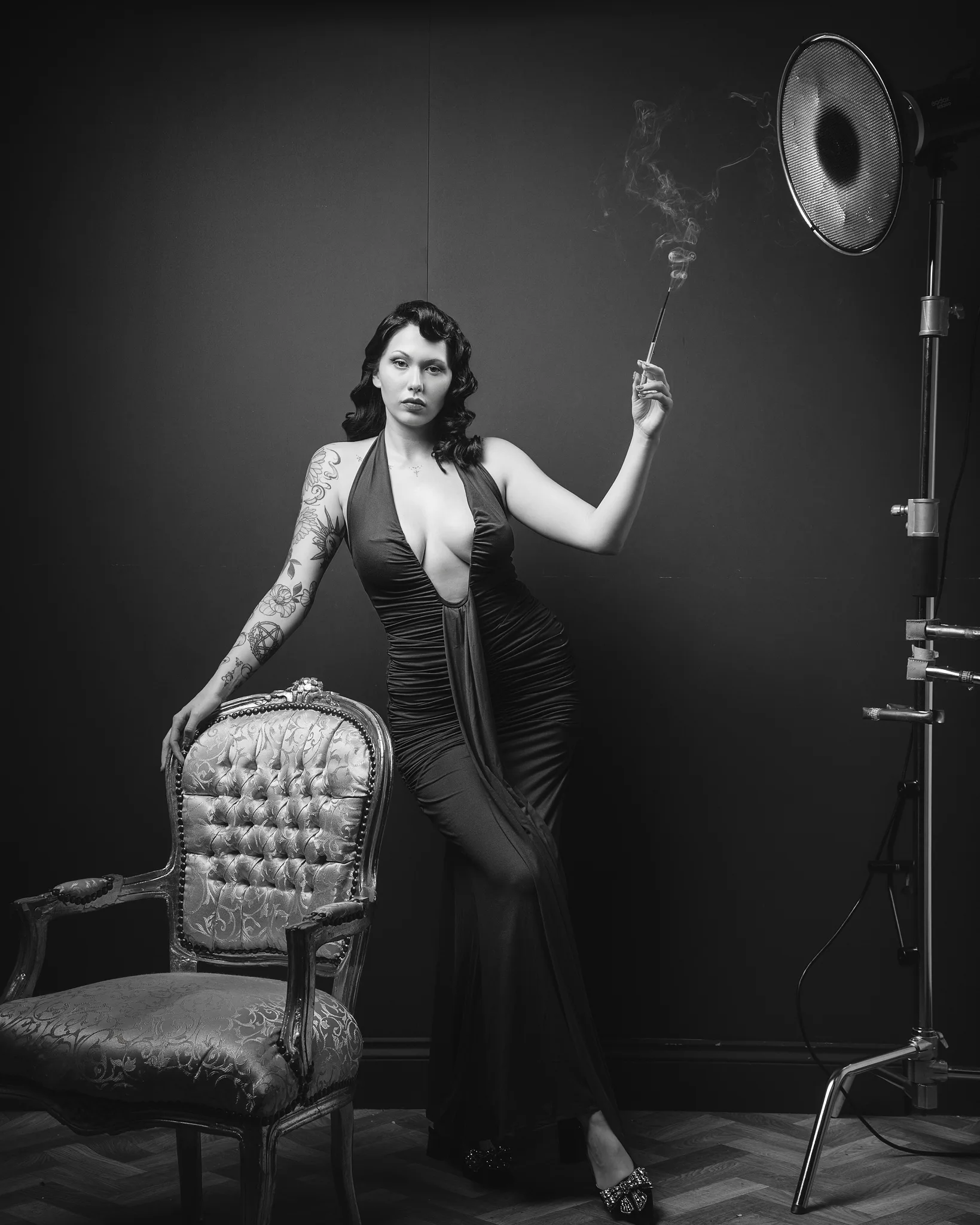
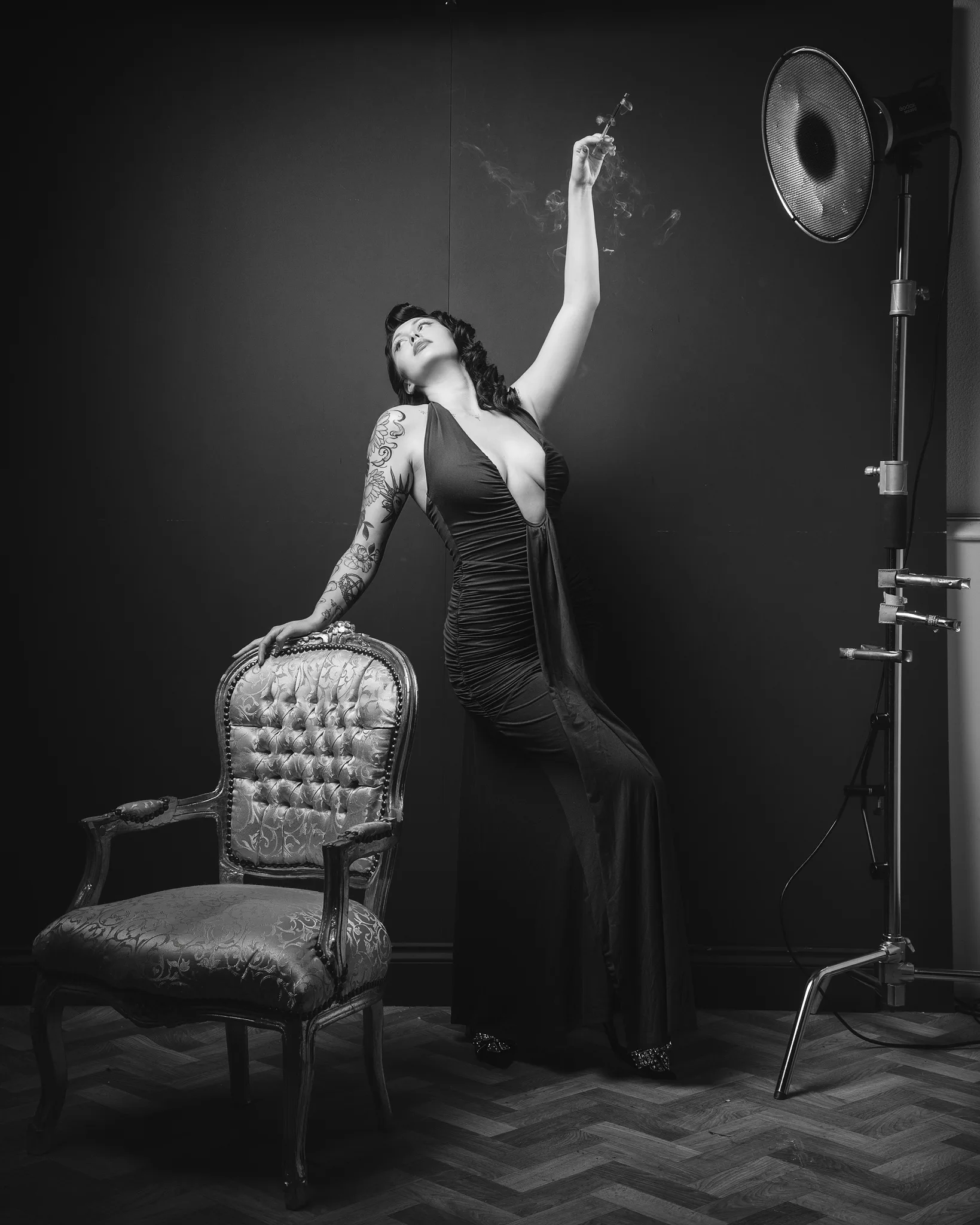
Courtney’s hair, makeup and styling
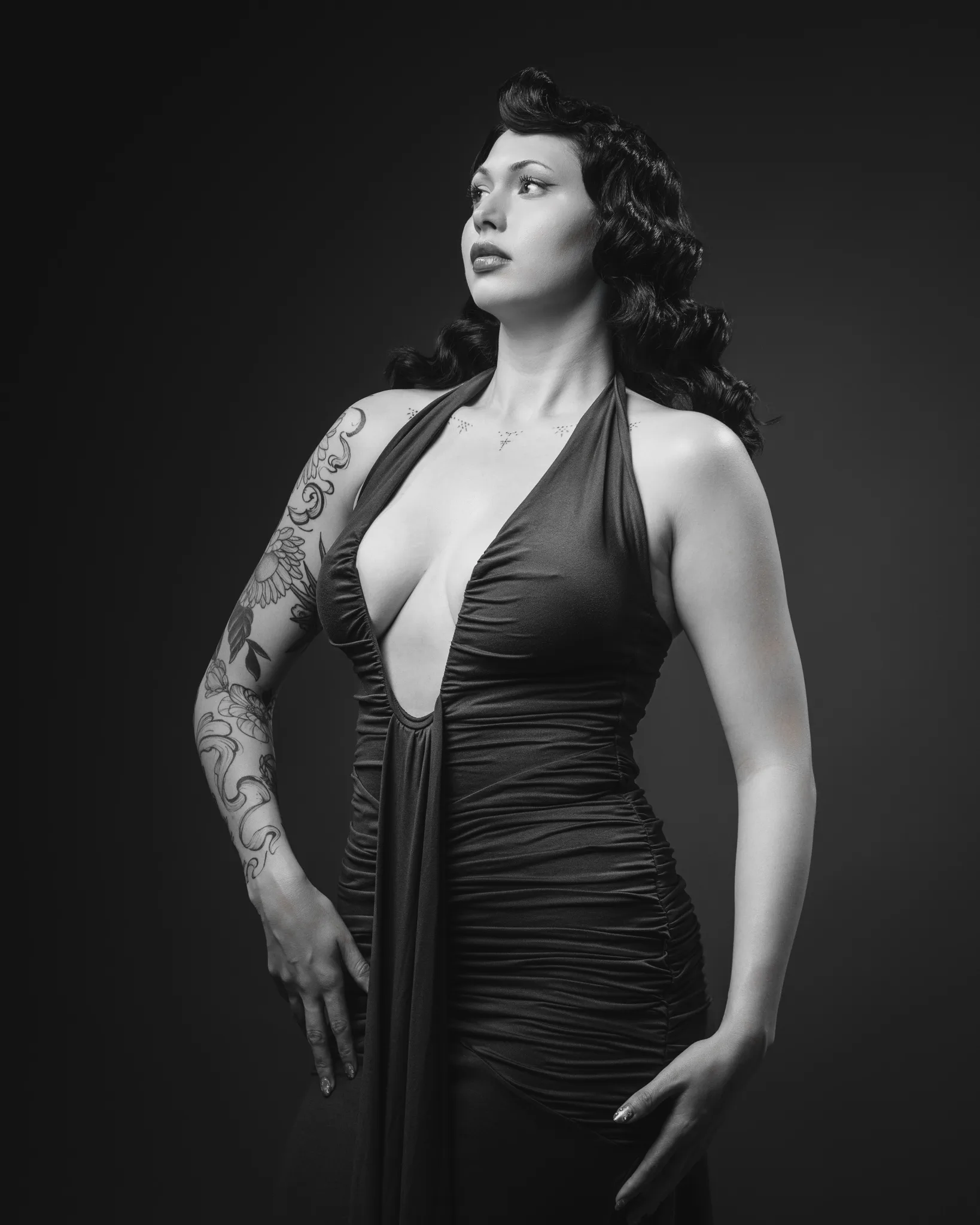
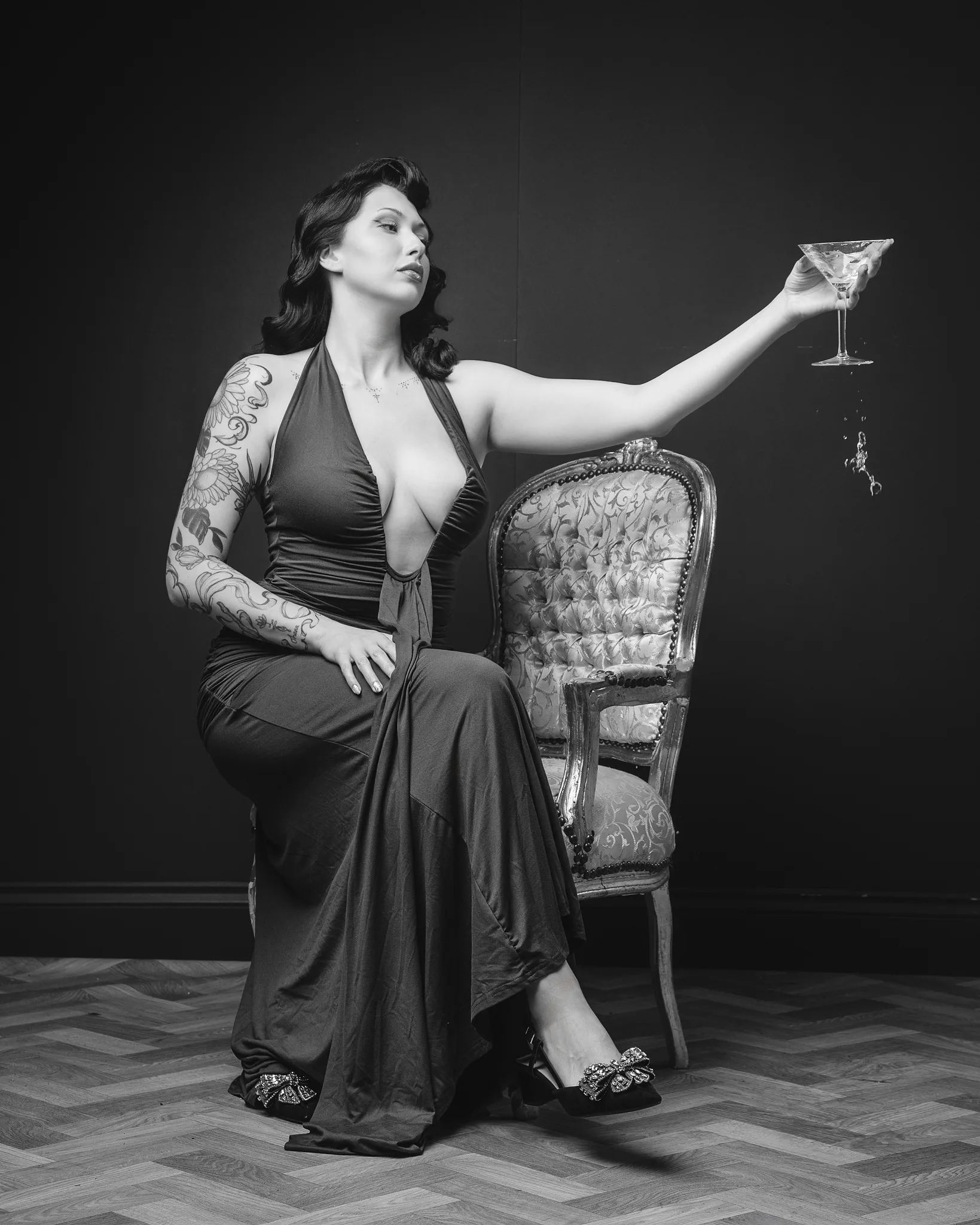
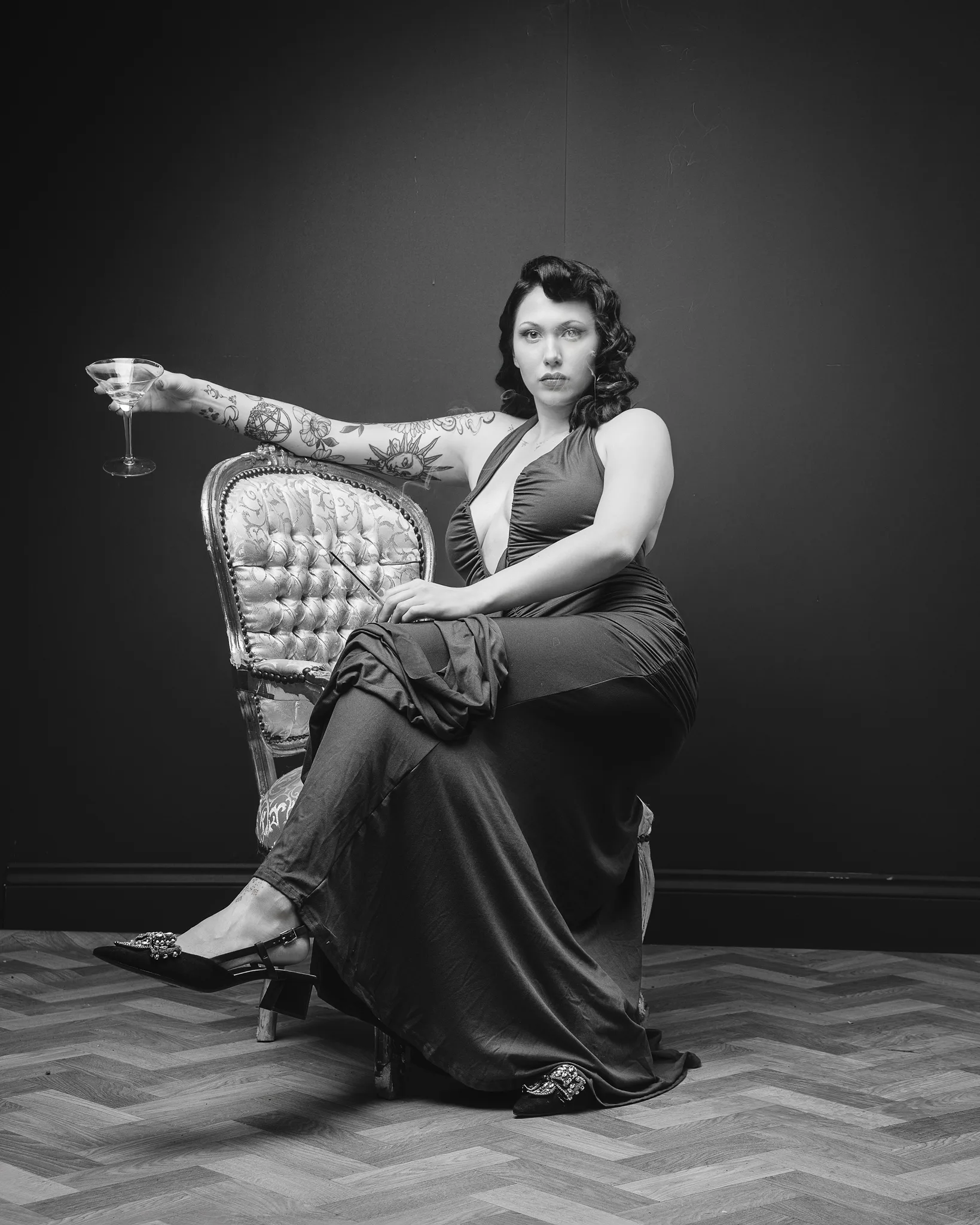
This shoot worked because of Courtney, and I want to be clear about how much of it was her. She modelled it, and she did her own hair, her own period makeup, and her own styling. The finger waves were set by her. The 1940s makeup was her work, and it read as accurate rather than fancy dress, which is a much harder thing to pull off than people realise. She styled the gown and the props so they sat right in the era.
That accuracy is the whole game with a shoot like this. If the hair is slightly off, or the makeup leans too modern, or the styling misses the period by a decade, the illusion tips straight into costume and the picture stops working. There is no lighting trick that saves it once that happens. Courtney carried the historical detail and the performance at the same time, and both had to land. She is a working makeup artist, so this is also a fair sample of what she can do for anyone sitting in her chair.
Building the shot
My side of it was the light. A single hard source, a black backdrop, and deep shadow doing most of the work. Hard light is unforgiving, which is exactly why it suits this. It shows structure, it carves out the cheekbones and the jaw, and it drops everything it does not touch into black. I shaped it to keep the face and the coupe glass bright and let the rest of the frame go dark.
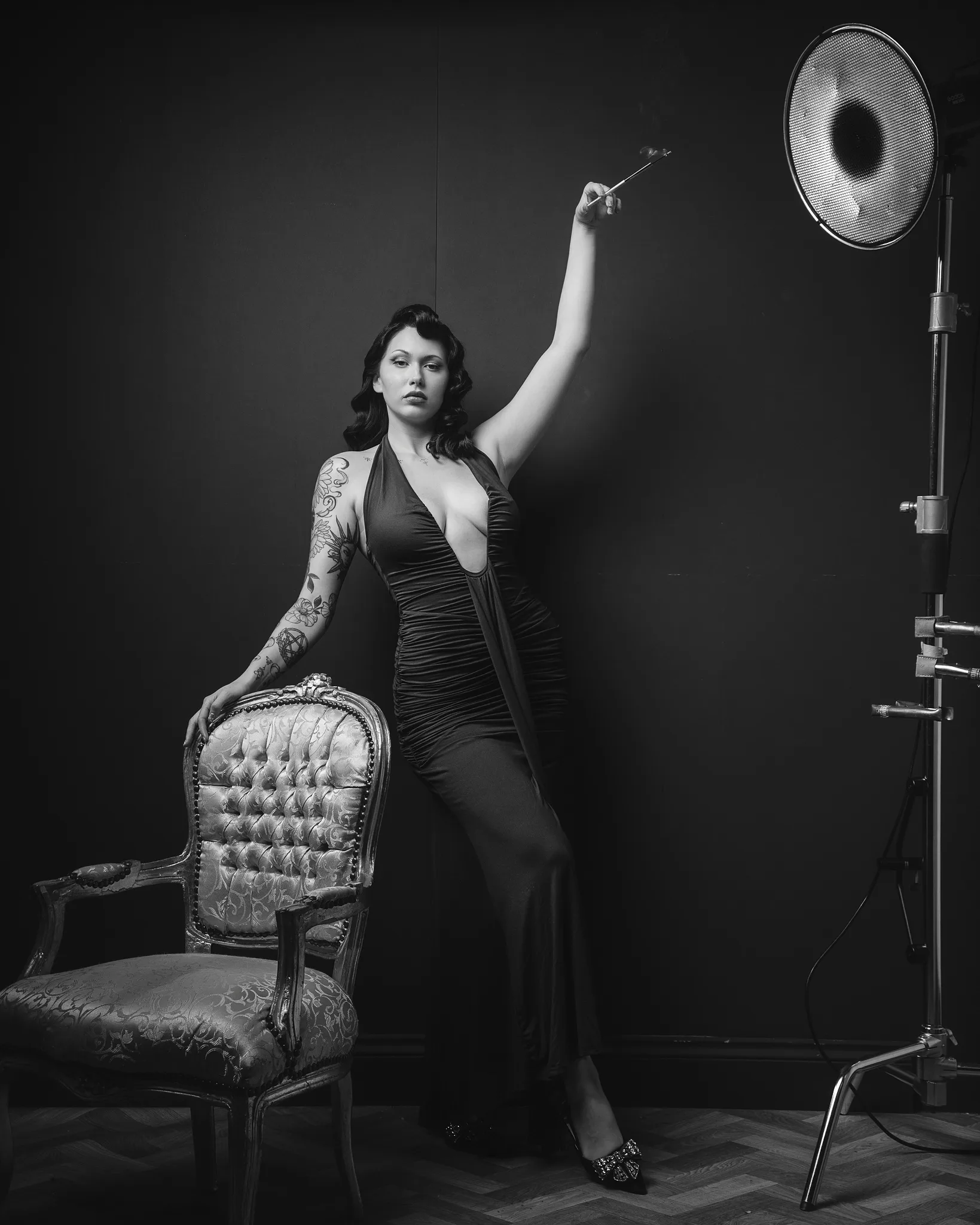
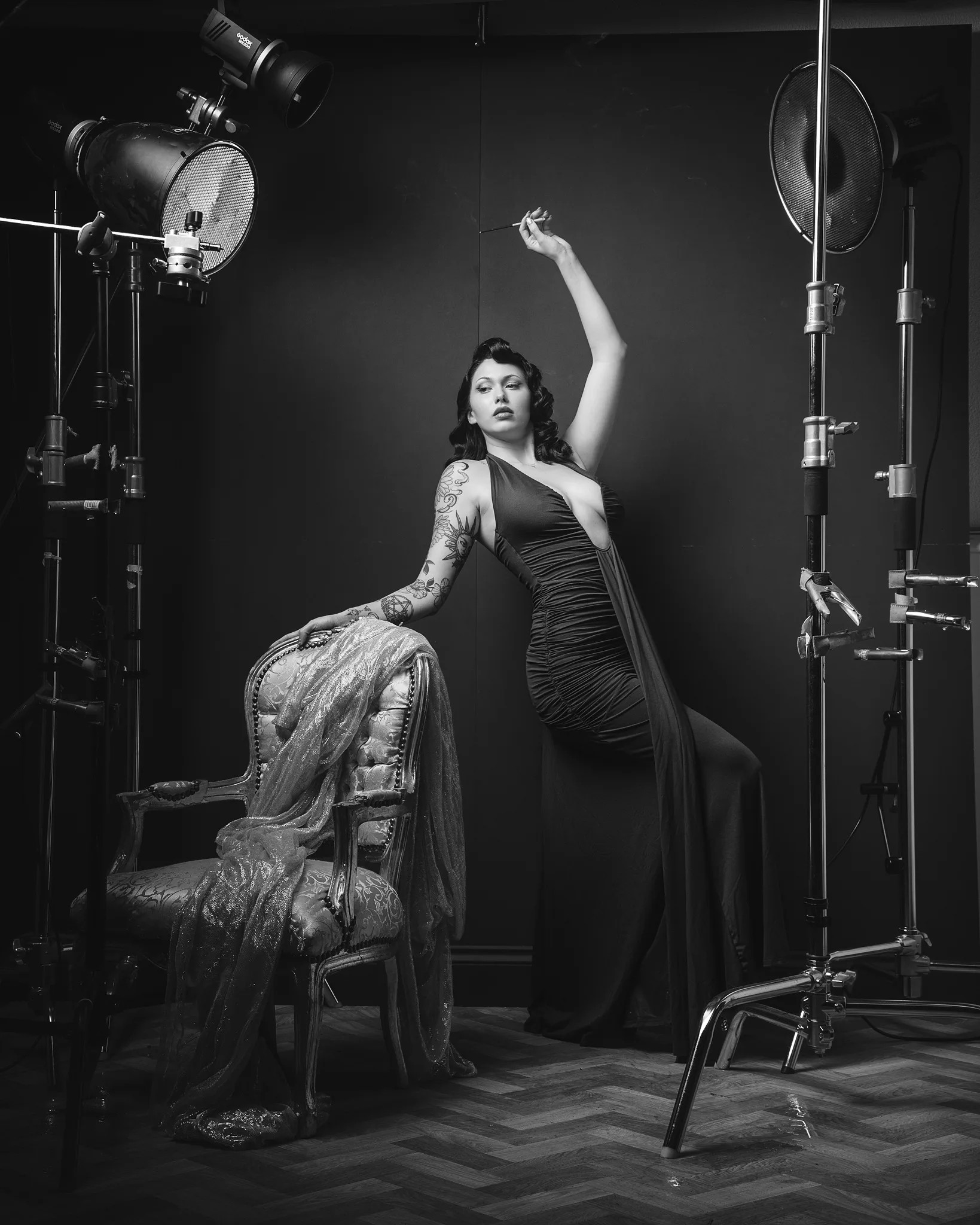
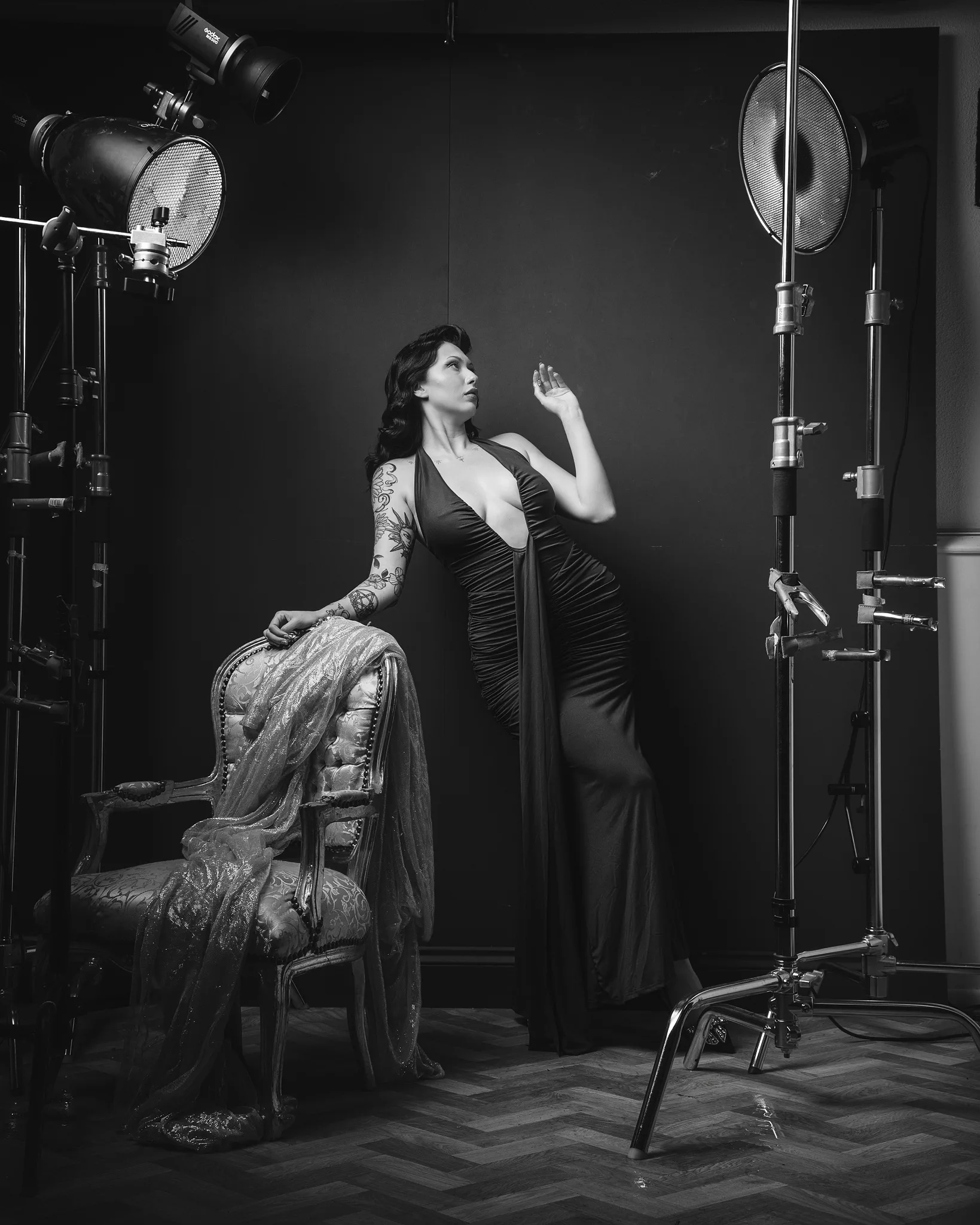
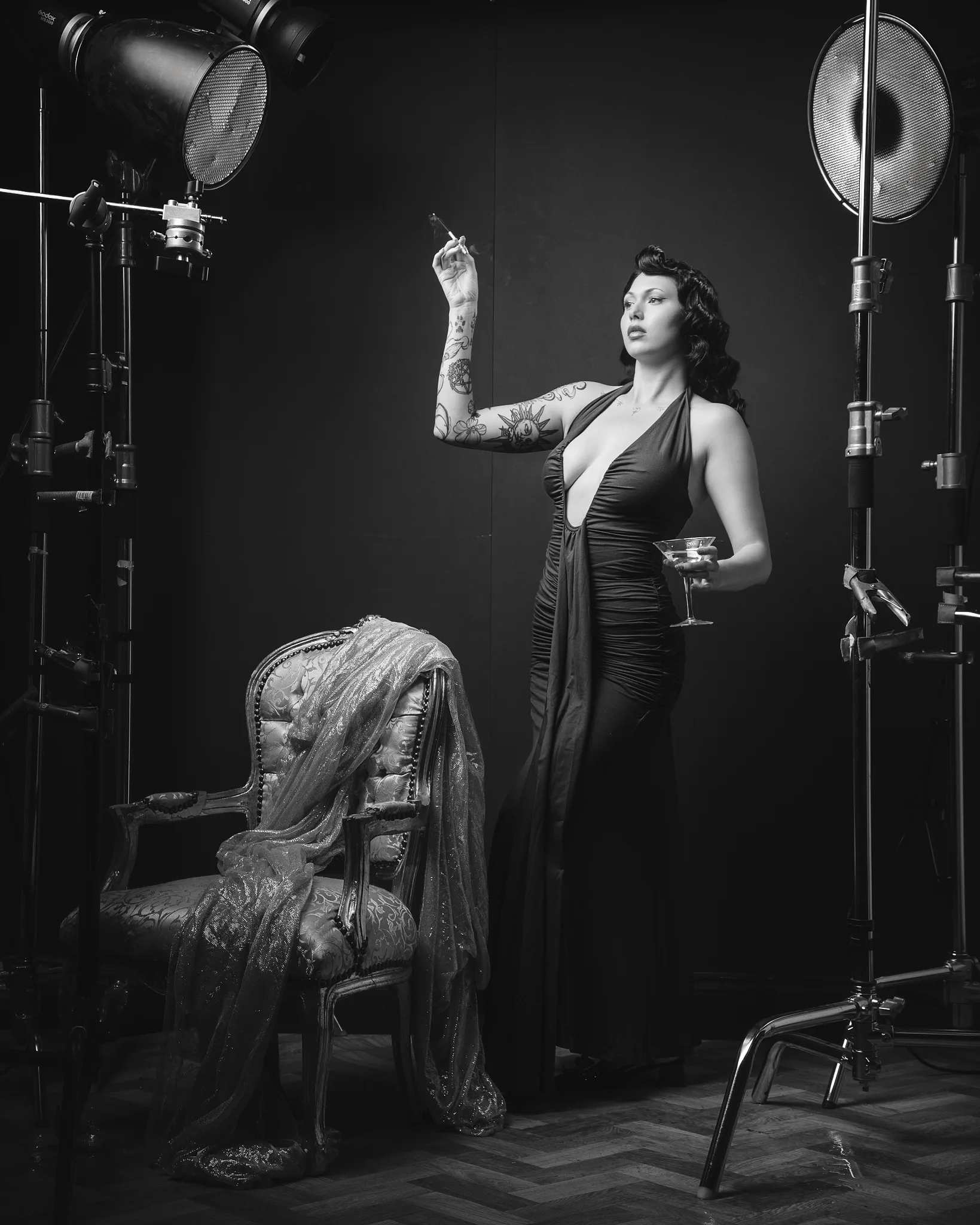
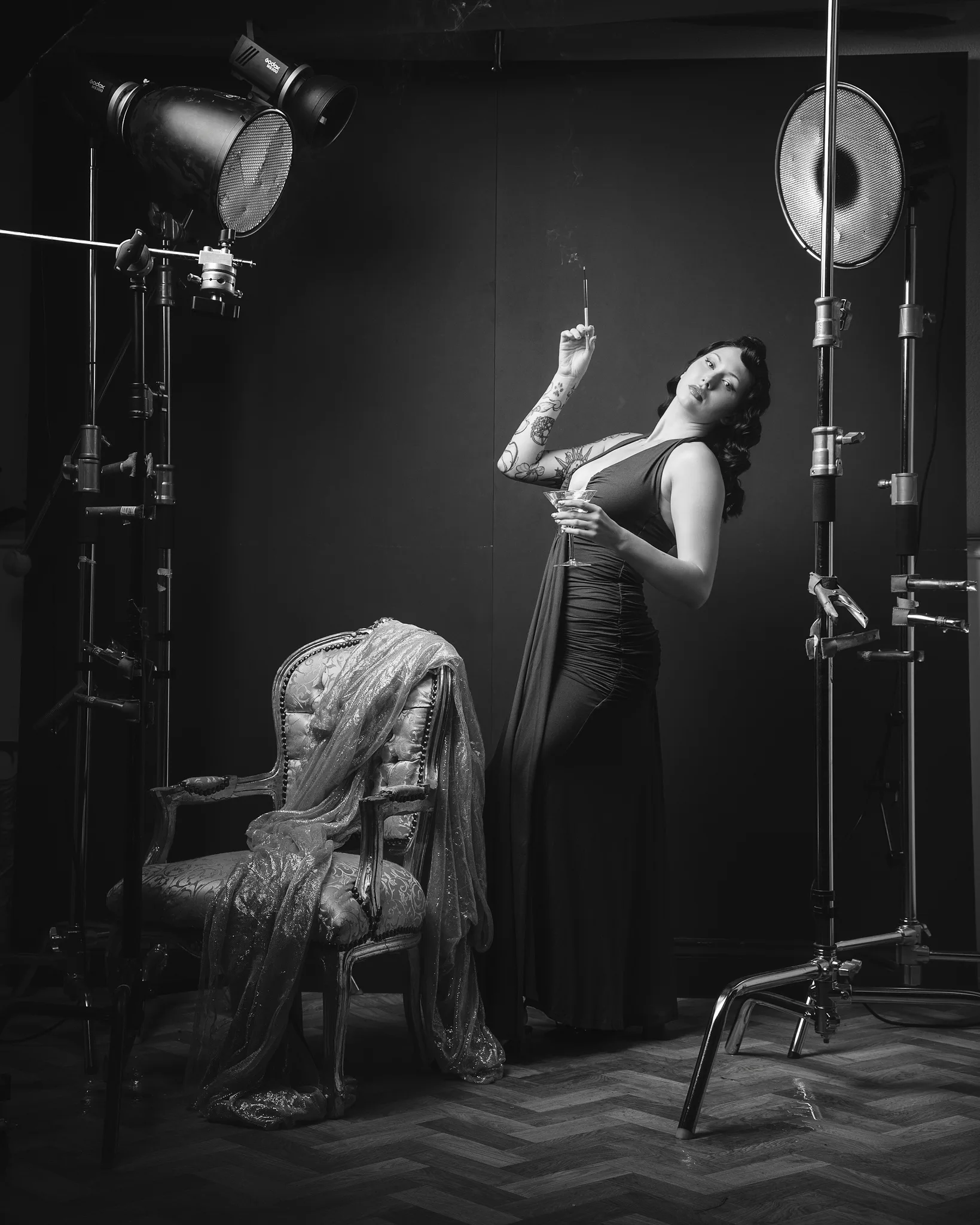
There is a second thread running through the set. Alongside the clean glamour frames, I pulled the camera back on some of them to show the beauty dish, the stands, and the studio around her. The polished shots and the working shots sitting side by side. I like showing that. The glamour is real, but so is the kit holding it up, and there is something honest about letting both exist in the same set.
The modern twist
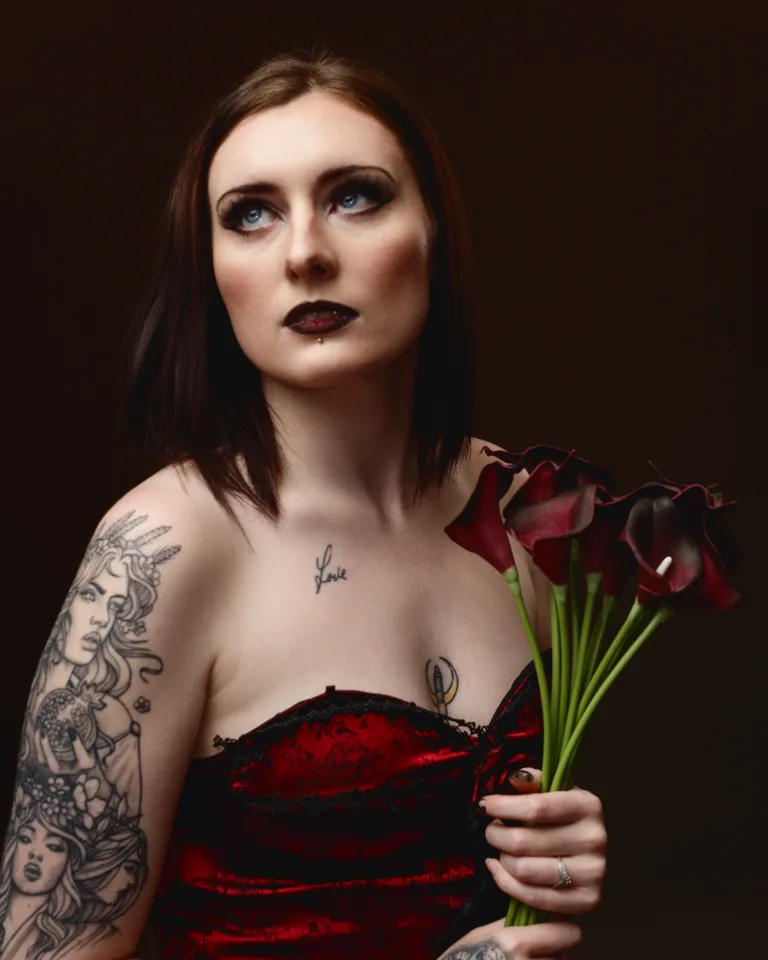
Here is where it stops being a museum piece. Courtney has tattoo sleeves, and against 1940s hair and a period gown they should not work. They do. The contrast is the point. Hurrell photographed a world that was airbrushed to a kind of impossible smoothness, and putting a modern, tattooed woman inside that frame pulls it into now. It stops being a re-enactment and becomes a portrait of a real person who happens to be styled to the nines. That tension between the era and the skin is what makes the set feel current rather than nostalgic.
The details
In a set this stripped back, the small things carry a lot. There is a martini in a coupe glass, including one frame where it spills, which I kept because it broke the poise in a way I liked. The cigarette holder and the ribbon of smoke off it, catching the light. The vintage French chair with its worn brocade, a bit of lace thrown over the back. None of it is there by accident. Every prop has to earn its place, and each of these gives the eye something to read in the dark.
In Courtney’s words
I asked Courtney how the shoot felt from her side of the camera. Her words: “Stepping in front of the camera for this photoshoot was such an empowering experience. From the moment it began, I felt confident, celebrated, and completely myself. Looking at these photos, I can honestly say I’ve never felt more beautiful than I did in that moment.” That is the whole point of a session like this, and it matters more to me than any single frame.
A note on model shoots and safety
This was a model portfolio shoot, and I say the same thing on every one of these regardless of who is in front of the camera. There is no physical contact between me and any model during a shoot. If a pose needs adjusting, I describe it or show it myself from where I am standing. I do not touch to correct.
I also encourage every model to bring a chaperone. A friend, a partner, a family member, whoever they trust. The offer is made before the shoot, every time, even if the model decides in the end to come alone. Any photographer who refuses a chaperone, or who tries to talk a model out of bringing one, is showing you something you should pay attention to. There is no honest reason to object. A model’s safety is not something they should have to argue for, and the right photographer will explain everything up front and be glad someone came along.
Where I work
I shoot from my studio at Base Business Park in Rendlesham, the old RAF Bentwaters site near Woodbridge in Suffolk. Dramatic studio portraits like these suit anyone who wants something with more weight to it than a standard sitting, whether that is a model building a portfolio or someone who simply wants a striking portrait of themselves. If that is the sort of thing you are after, whether a portrait session or a full model portfolio shoot, get in touch and we can talk through what you have in mind.