
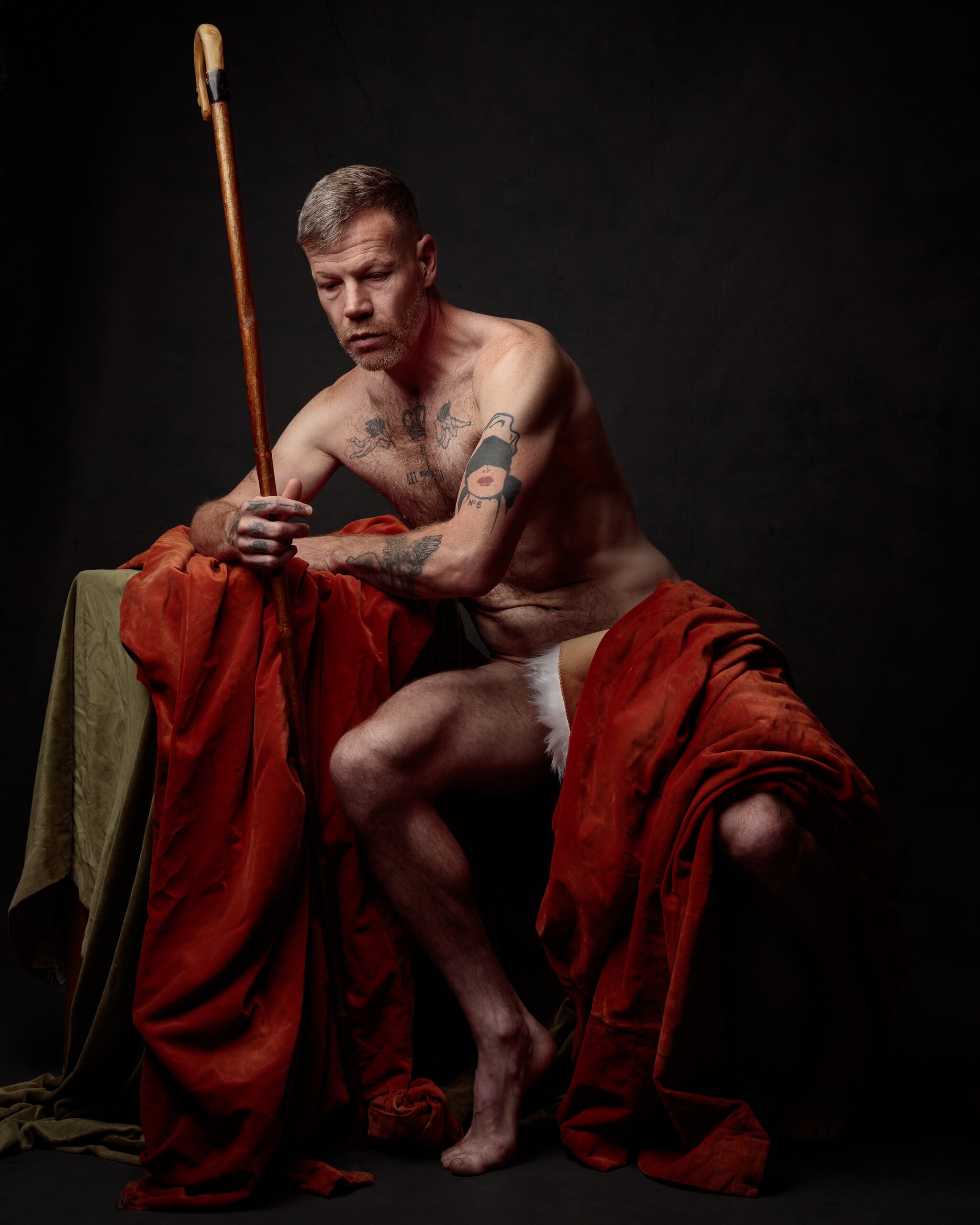
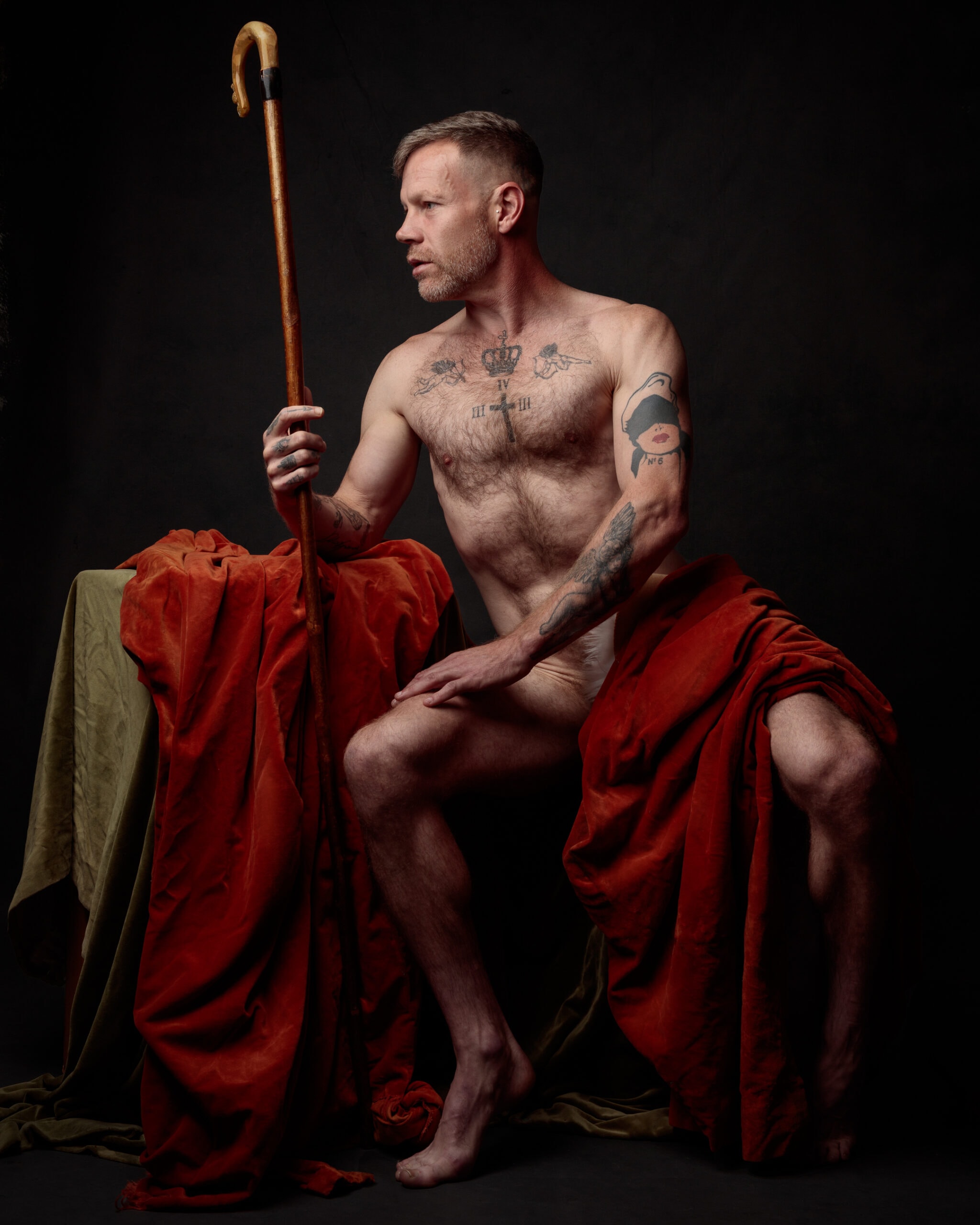
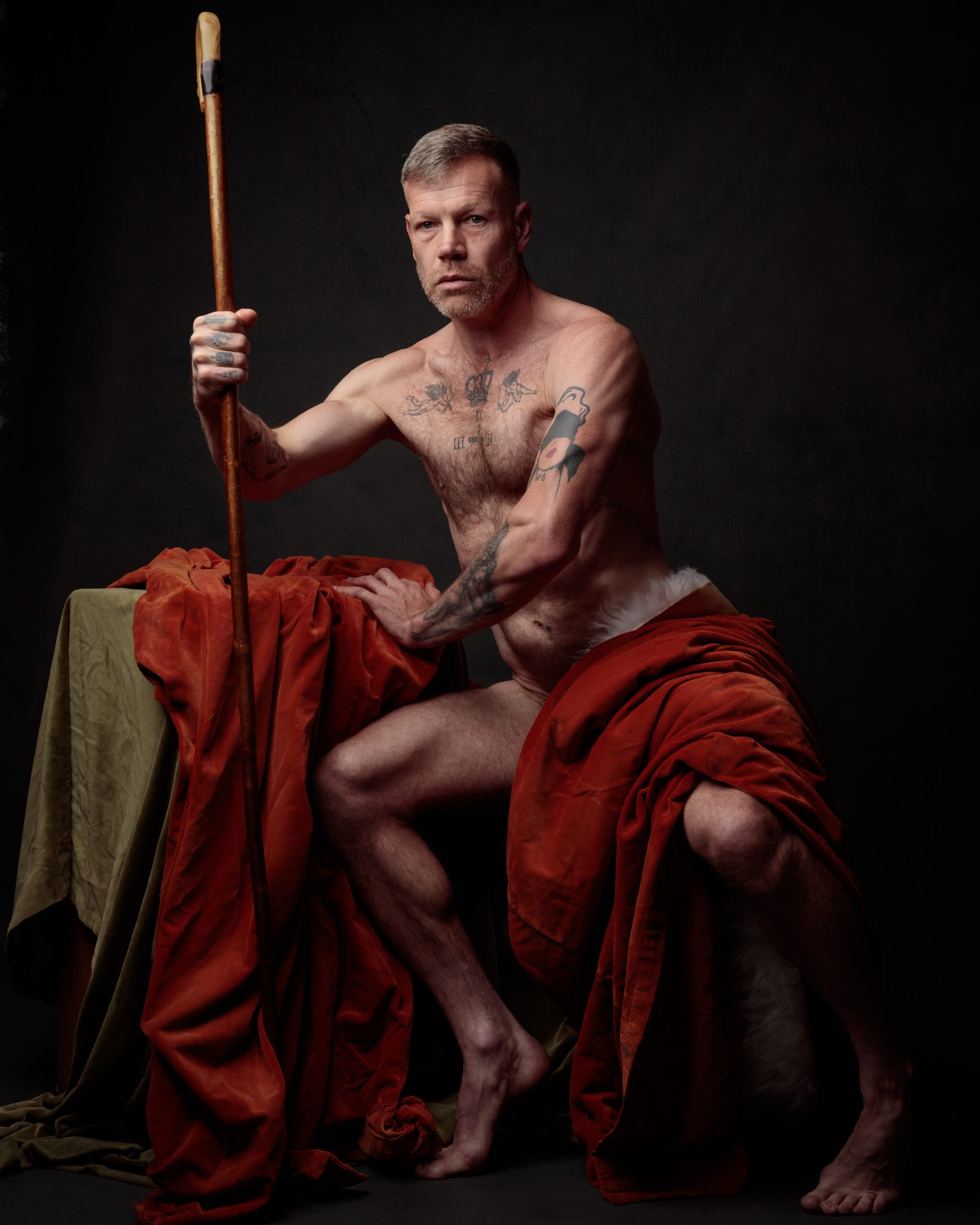
Following on from my portraits in homage to the Rokeby Venus, I recently expanded this personal project to include my take on Caravaggio’s St John the Baptist in the Wilderness. I wanted to portray Caravaggio’s St John, a brooding, melancholic adolescent, with a slightly modern twist. Craig was the perfect choice for the recreation, with his strong physique and multiple tattoos. I felt the set would work as a triadic, so Craig and I shot a series of three separate portraits. I love that Caravaggio used real people in his paintings, along with a limited palette, and that’s something I tried to hold on to.
I’m an art lover with a deep appreciation for the Old Masters, and Caravaggio is one of my all-time favourites. His impact on the Baroque style that grew out of Mannerism was significant. You can see it in the work of Peter Paul Rubens, Jusepe de Ribera, Gian Lorenzo Bernini and Rembrandt. Artists influenced by him were called the “Caravaggisti” or “Caravagesques”, and also “tenebristi” or “tenebrosi”, meaning “shadowists”.
One painting I keep coming back to is his “St John”, made in Rome towards the end of his career, where his mature style really shows. It’s a fine example of tenebrism, the dramatic contrast of light and shadow. Caravaggio built it through close observation and precise chiaroscuro, an Italian term meaning “light-dark”. I’m a keen fan of chiaroscuro, and I think “St John” shows his skill with the play of light and shadow at its best.
Alongside that, Caravaggio was known for his realism and his eye for detail. He wasn’t afraid to paint his subjects raw and unidealised, often using ordinary people as his models. That was revolutionary at the time, and it’s a big part of why his work still holds up.
I also admire how he carried emotion and drama through colour and composition. His paintings are full of tension and movement, which makes them feel alive. You can see it in “The Taking of Christ”, where the expressive faces and the dramatic light create a real sense of chaos and urgency.
His career wasn’t without controversy. He led a turbulent and often criminal life, and his paintings frequently carried themes of violence and sensuality. Several were thought so scandalous that the churches and patrons who commissioned them turned them away. Even so, his talent and invention couldn’t be ignored, and he became one of the most celebrated painters of his time.
Something else I find interesting is the way he used light to build drama and atmosphere. In “The Calling of St Matthew”, the beam that lights St Matthew and the figures around him pulls your eye straight to the heart of the scene. That handling of light is central to his style, and a big reason his paintings stay with you.
For more on the personal projects I’ve taken on, take a look at my portfolios. If you’d like to get involved with future projects, get in touch. I’m always on the lookout for people to photograph.
Get in touch
Have a question? Want to find out more?
Don’t be a stranger, just say hello.
 Bob Foyers
Photographer, Foyers Photography
Bob Foyers
Photographer, Foyers Photography
If you have not heard back within 24 hours, please check your spam folder for my reply. This is especially common with Hotmail, Gmail and Yahoo accounts.